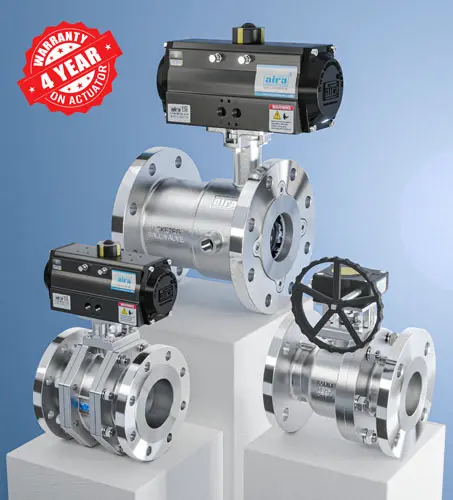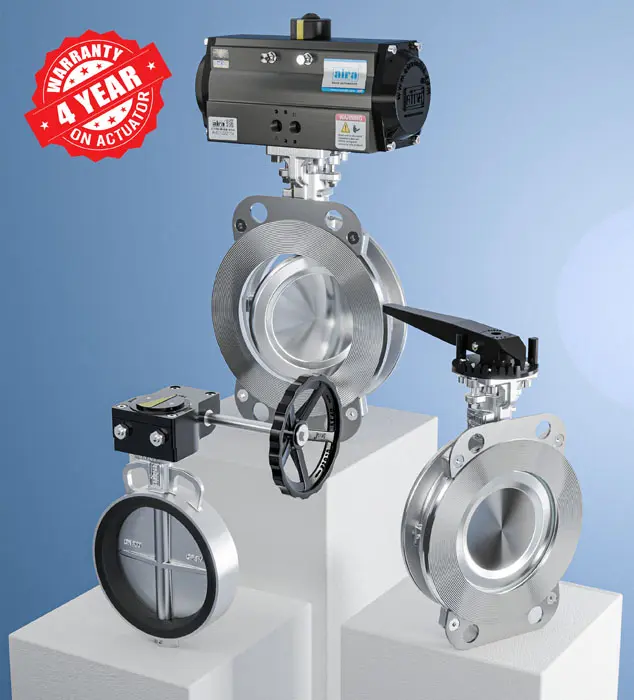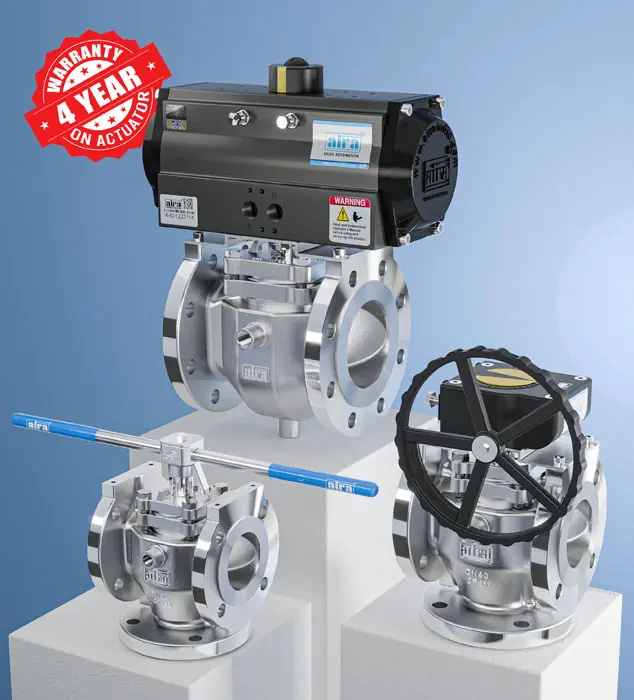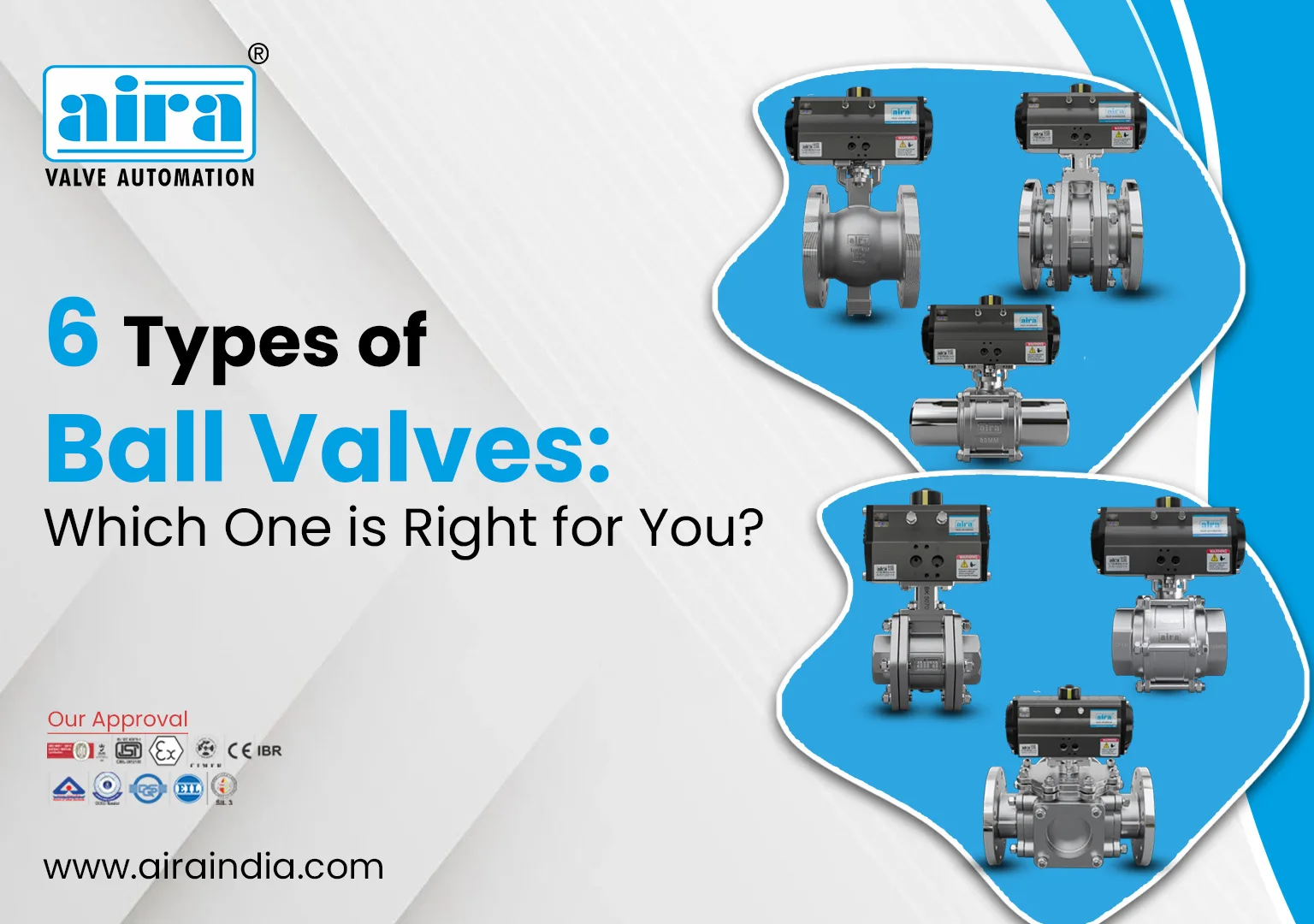
Pneumatic Actuated Quarter Turn Valves play an important role in controlling the flow of either a gas or a liquid, thus finding use in hundreds of different industries. These quarter-turn valves are Ball Valves, Butterfly Valves, & Plug Valves require just a 90° turn to come into action. Primarily, Ball Valves are the most common quarter-turn actuated valves. Every valve manufacturer knows that there are at least 6 important kinds of Ball valves.
So, let’s get ourselves familiarized with them too…
What is a Pneumatic Actuated Ball Valve?
A pneumatic actuated ball valve combines a ball valve body with a pneumatic actuator that uses compressed air to automate the open/close operation. Instead of a manual handle, the actuator rotates the ball 90° on receiving an air signal — making it ideal for remote operation, high-cycle applications, and hazardous environments where manual access is impractical.
- Double Acting (DA): Uses air to both open and close — ideal for standard automation
- Single Acting / Spring Return (SA): Uses air in one direction; spring returns valve to a fail-safe position on air loss
High Pressure Ball Valves
These are quarter-turn ball valves that make use of a floating ball to control flow. The valve remains open only when the holes in the ball are in line with the flow; they remain closed when, using the valve handle, you pivot them at 90 degrees.
- Common industries: Oil & gas pipelines, refineries, hydraulic systems, steam lines
- Why pneumatic actuation? Automated cycling under high pressure reduces operator risk and improves response time in critical shutoff scenarios
- Actuator pairing: Typically paired with double acting or spring return actuators for fail-safe operation
Two Piece Ball Valves
Most industries use these 2 piece ball valves. The name itself suggests its construction; while the first piece has one end connection as well as the body, the second one fits right into the first and includes the second end connection. The latter one also holds the trim in place.
- Common industries: General industrial automation, water treatment, HVAC, chemical processing
- Why choose this? Most cost-effective option for standard on/off pneumatic automation with straightforward flow requirements
- Limitation to note: Requires full removal from the pipeline for maintenance – consider 3 piece if servicing frequency is high
Three Piece Ball Valves
Just as the name suggests, this one consists of 3 pieces. There are 2 end caps and a body. You will find the end caps to be typically welded or threaded to the pipe. The main body section is generally easily removable so that it can be cleaned or repaired without having to remove the end caps.
- Common industries: Pharmaceutical, food & beverage, petrochemical, high-purity fluid systems
- Why choose this? The body can be removed for cleaning (CIP/SIP) or repair without removing the valve from the pipeline — significantly reducing downtime
- Why pneumatic actuation? Automated operation eliminates human contact with process media, critical in hygienic and hazardous environments
Stainless Steel Ball Valves
Stainless steel is usually preferred by ball valve manufacturers over brass. It’s because stainless steel ball valves tend to hold up much better to harsher water types, which ensures a longer-lasting valve. Also, as a material, it’s known to be much more resistant to corrosion than brass. This is an important quality because valves are meant to open and close, and corrosion can cause a ball valve to either break or simply render it unable to move.
- Common industries: Chemical plants, marine, dairy & food processing, pulp & paper
- Why choose this? Where media is aggressive or hygiene standards are strict, stainless steel outperforms brass or carbon steel over the valve’s lifecycle — reducing replacement costs
- SS 304 vs SS 316: SS 316 / 316L is recommended for chloride-rich or acidic environments; SS 304 suits general industrial use
Wafer Ball Valve
Wafer ball valves are cavity-free, meaning there is no cause for disturbance because of residual products polymerizing, crystallizing, and thus affecting the valve’s functioning. These come with a push-fit insert design, which furthers the distance between the actuator mounting flange and the vessel. It makes the isolation of the vessel and the ball valve automation more convenient.
- Common industries: Slurry handling, adhesive lines, polymer processing, chemical dosing
- Why choose this? The cavity-free design prevents residual media from crystallizing or polymerizing inside the valve — a common failure point in standard ball valves handling viscous or reactive fluids
- Space advantage: Installs directly between pipeline flanges, making it ideal where space or weight is a constraint
UPVC Ball Valves
These ball valves come with a durable design, manufactured using a top-grade material – Virgin UPVC. With proper finishing, manufacturers ensure these valves are leak-free and give a smooth performance. These valves find wide applications in domestic, plumbing, and irrigation purposes, to generally ensure a seamless flow control in the water supply lines.
- Common industries: Water treatment plants, irrigation networks, swimming pools, domestic plumbing
- Why choose this? Non-metallic and non-conductive, making it the preferred choice where metal contamination is a concern or where cost must be minimized without sacrificing corrosion resistance
- Limitation to note: Not suitable for high-pressure or high-temperature applications — for those, consider stainless steel or high pressure ball valves
Quick Comparison: All 6 Types of Pneumatic Actuated Ball Valves
| Valve Type | Best For | Key Advantage | Limitation |
|---|---|---|---|
| High Pressure Ball Valves | Oil & Gas, Refineries, Steam Lines | Handles extreme pressure safely | Higher cost; heavy construction |
| 2 Piece Ball Valves | General Industrial, HVAC, Water Treatment | Compact, cost-effective, widely available | Must be removed from pipeline for service |
| 3 Piece Ball Valves | Pharma, Food & Beverage, Petrochemical | In-line serviceable without depipeing | Slightly higher cost than 2 piece |
| Stainless Steel Ball Valves | Chemical, Marine, Dairy, Pulp & Paper | Best corrosion and temperature resistance | Higher material cost than brass or carbon steel |
| Wafer type Ball Valves | Slurries, Polymers, Chemical Dosing | Cavity-free; no residue buildup risk | Not suitable for high-pressure applications |
| UPVC Ball Valves | Water Treatment, Irrigation, Domestic | Corrosion-resistant, lightweight, lowest cost | Not for high pressure or high temperature |
Types of Pneumatic Actuators Used with Ball Valves
The right actuator type is just as important as the valve itself. Here are the two main pneumatic actuator configurations used with the above ball valves:
Double Acting Actuator (DA)
Uses compressed air to both open and close the valve. Best for standard automation where a continuous air supply is available. Offers faster cycle times and is suited for high-frequency switching operations.
Single Acting / Spring Return Actuator (SA)
Uses air pressure in one direction; a spring returns the valve to its default (normally open or normally closed) position on air failure. The preferred choice for fail-safe and critical shutdown applications in oil & gas, chemical, and pharmaceutical plants.
Also read: