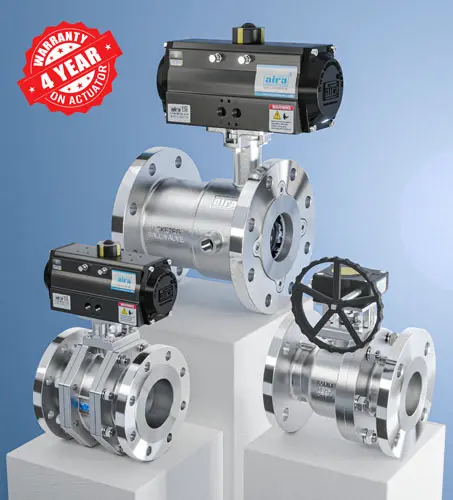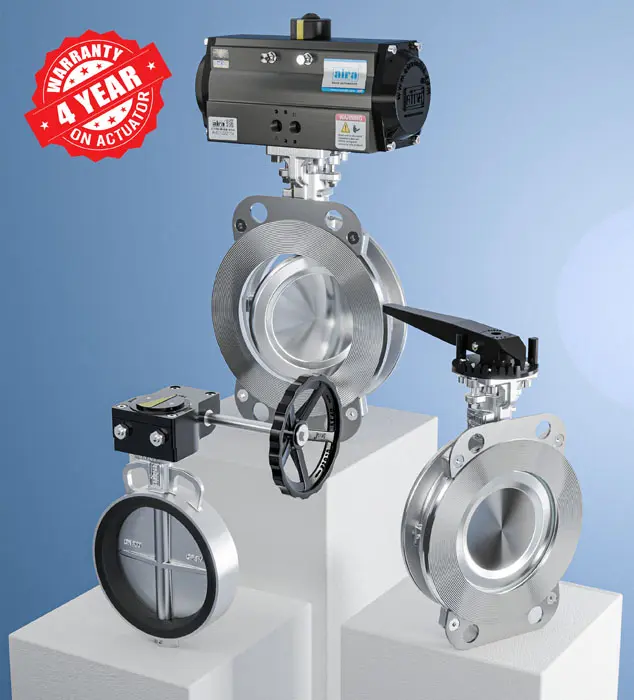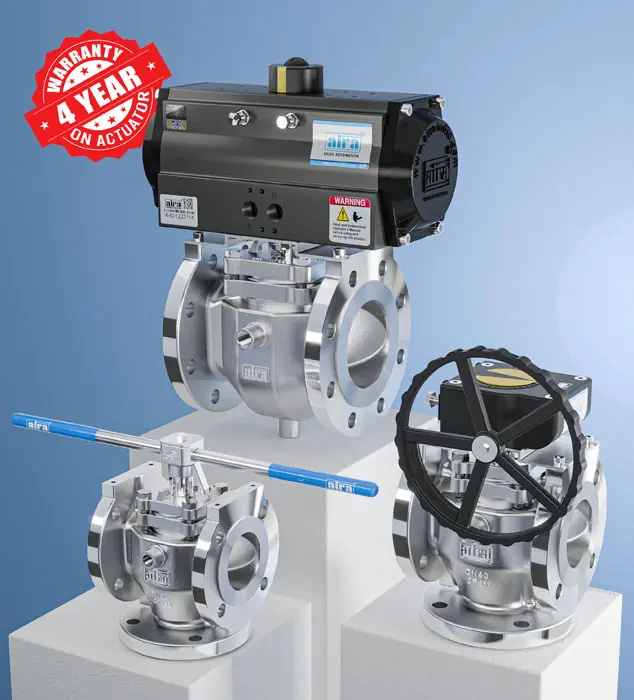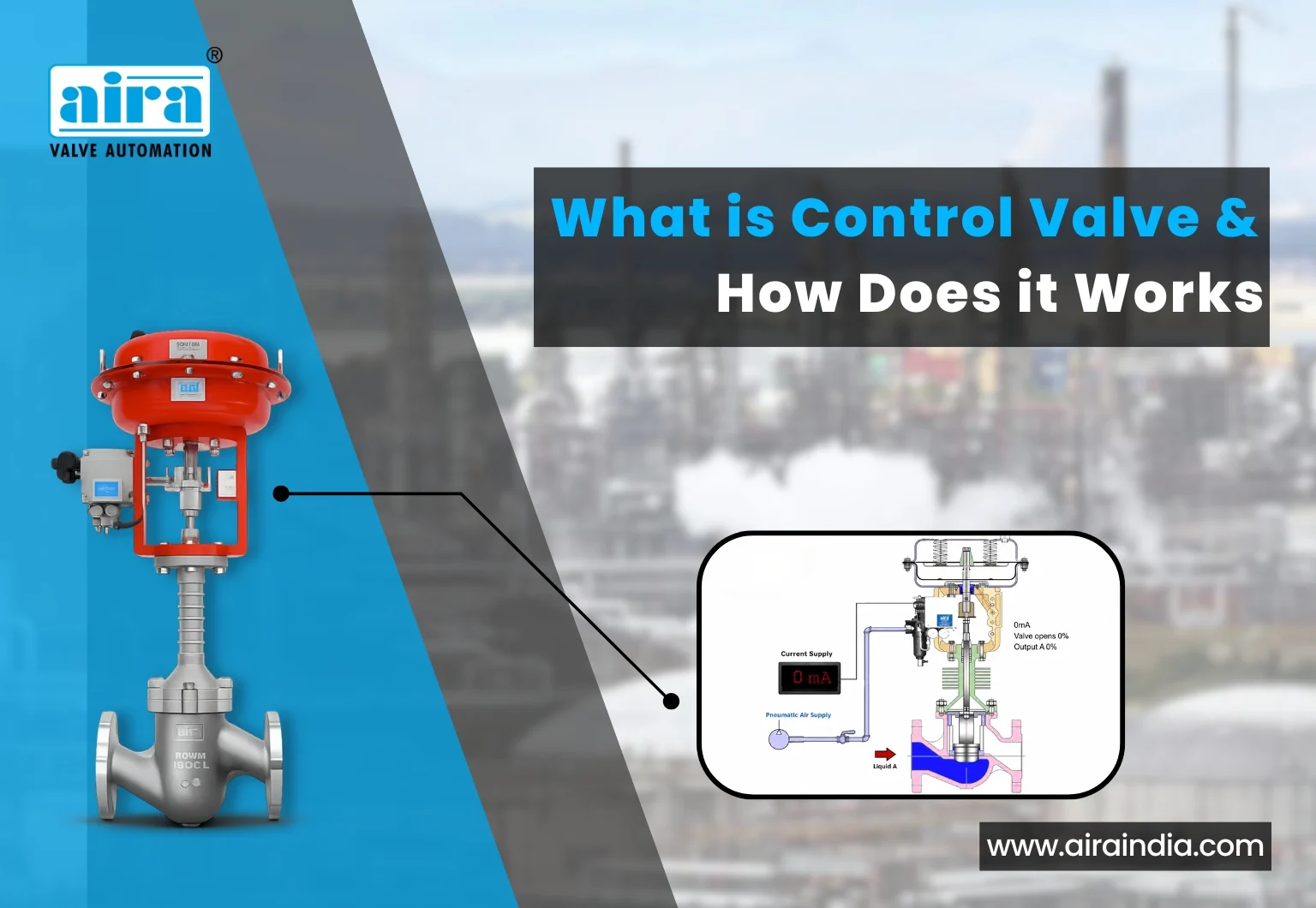
As the title suggests, this guide explores everything about control valves. Many valves, such as ball valves and butterfly valves, also regulate flow, but a control valve is a more advanced device designed for precise automation. It plays a critical role in controlling flow, pressure, temperature, and fluid levels, making it an essential component in modern industrial systems.
What is a Control Valve?
A control valve is an automatic valve that regulates the flow of fluids by adjusting the size of the flow passage based on signals received from a controller. It allows the direct control of flow rate that drives the control over process quantities like pressure, temperature, and liquid level.
Here’s how control valves differ from other common valve types:
| Feature | Control Valve | Ball Valve | Butterfly Valve |
|---|---|---|---|
| Automation | Fully automatic | Manual/automatic | Manual/automatic |
| Precision Control | High | Low | Medium |
| Use Case | Process control | On/off flow | Flow regulation |
| Complexity | High | Low | Medium |
How Does a Control Valve Work?
The control valve’s working principle is based on receiving a signal from a controller and adjusting the valve position accordingly. The control valve has a complex mechanism; it works with the help of a few external parts. First of all, we explore the main valve body.
This linear motion control valve has two ports, the inlet & outlet. There is a linear motion plug used as a barrier in the valve body, which is connected with the centric stem or shaft, and this shaft is connected to the diaphragm on the other end. To operate the control valve, need to energize the diaphragm. When the diaphragm goes up, the stem also lifts the plug inside the body and allows the fluid to pass through it.
There is a valve positioner fitted near the valve stem to control the opening and closing of the valve as per the direction received from the control room.
On top, there is an actuator fitted to operate the control valve. Generally, these actuators are pneumatic, hydraulic, or electronic. There is a diaphragm connected to the centric stem inside the actuator. When the diaphragm goes up, the plug also lifts with the help of the stem.
Here are the main components of a control valve and their functions:
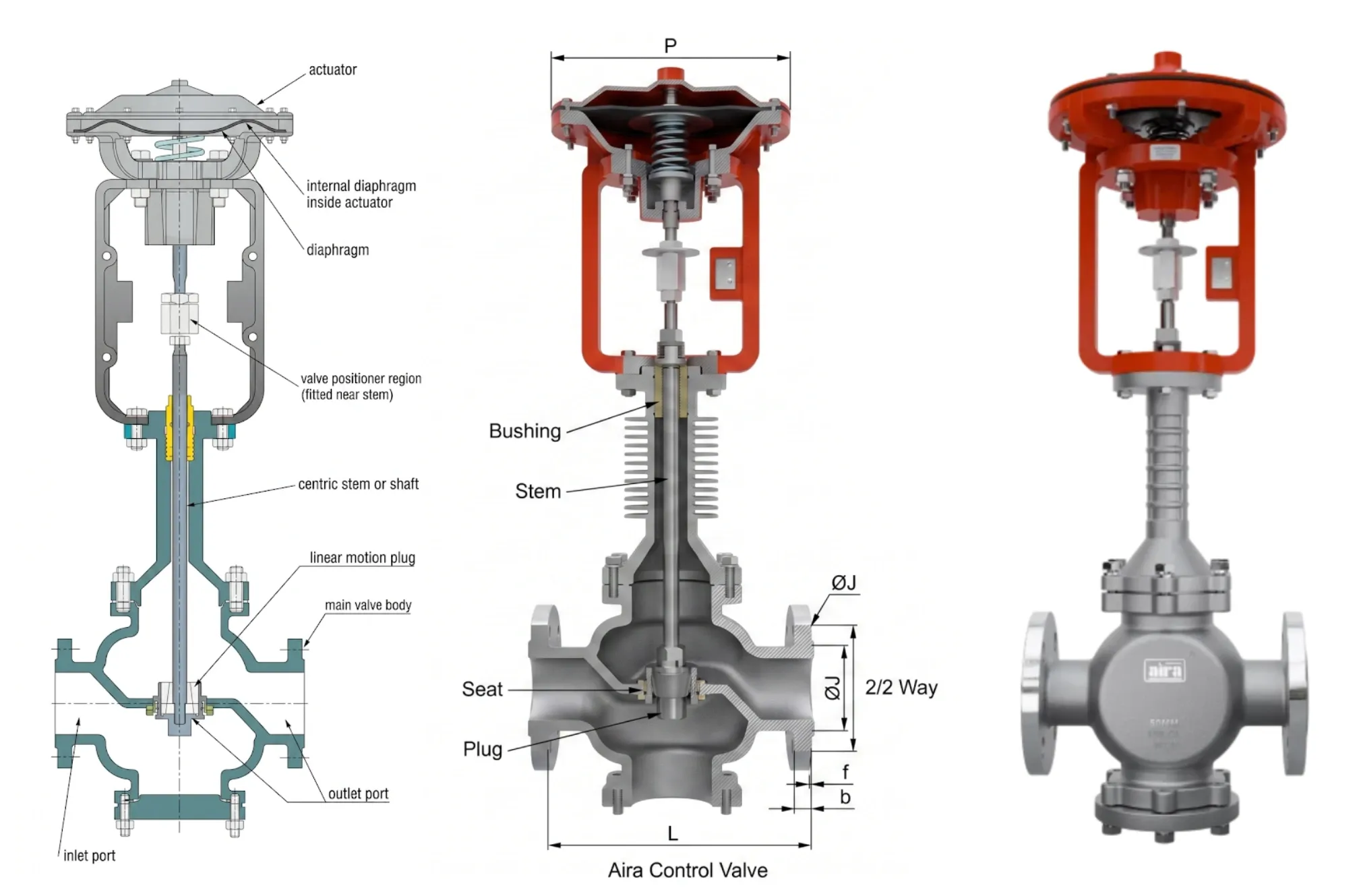
| Component | Function |
|---|---|
| Valve Body | Houses internal components and provides a flow path |
| Plug (Disc) | Controls the flow by opening or closing the passage |
| Stem | Connects the plug to the actuator and transfers motion |
| Actuator | Moves the stem based on control signal s (pneumatic, electric, hydraulic) |
| Diaphragm | Converts pressure (air/fluid) into mechanical movement |
| Positioner | Ensures accurate valve positioning based on control signals |
| Inlet Port | The entry point of fluid into the valve |
| Outlet Port | Exit point of fluid from the valve |
You will also like to read- Introduction of a 3 Way Control Valve, a comprehensive guide on 3 Way Control valve.
Control Valve Operation
Control valve operation involves continuous monitoring and adjustment of system parameters. When the operator sends the command to open or close the valve fully or partially or at any set point, the positioner decides how much the actuator has to energize to get the set point result. If there is a pneumatic actuator, then the valve positioner will decide and supply the accurate amount of pneumatic air to the actuator.
For example, if the operator sends the command to open the valve for 50%. Then the valve positioner allows that required amount of pneumatic air to the diaphragm, and there is a plunger connected to the stem that will measure the current valve position.
Control valves use different types of actuators, as shown below:
| Actuator Type | Working Principle | Common Use |
|---|---|---|
| Pneumatic Actuator | Uses compressed air to move the valve | Most common in industries |
| Electric Actuator | Uses an electric motor for precise control | Automated systems |
| Hydraulic Actuator | Uses fluid pressure for high force | Heavy-duty applications |
There are two types of pneumatic actuators available: air to open and air to close. Air to open is also known as normally closed, and Air to close is known as normally open.
Control Valve Function
The primary function of a control valve is to regulate flow, pressure, temperature, and fluid levels within a system. It ensures that industrial processes operate within safe and efficient limits, improving system performance and reducing energy loss.
Where are Control Valves used?
Control valves are widely used across industries where precise control is required. They are essential in applications such as steam systems, water treatment, oil and gas, and manufacturing processes. In many industries, an exact point of temperature is required in the process; in that scenario, steam has been used as a heating element. The control valve shows its best performance in this condition to maintain the temperature for the working process.
Conclusion
At the end of this article, we must agree that the control valves are the most intelligent and advanced valves in the valve industry. The control valve manufacturers are ready to make valves as per the process needs. Aira Euro Automation is one of them. We are always ready to accept challenges in the making of modern industrial valves. Contact us today to find the right solution for your application.
Frequently Asked Questions (FAQs) About Control Valves
What is a control valve and how does it work?
A control valve is an automatic device used to regulate the flow, pressure, temperature, or level of fluids in a system. It works by receiving signals from a controller and adjusting the valve opening through an actuator.
What is the function of a control valve?
The primary function of a control valve is to regulate flow, pressure, temperature, and fluid levels within a system.
What are control valves used for?
Control valves are used in industries like water treatment, oil and gas, steam systems, and manufacturing to regulate fluid flow.
What is the working principle of a control valve?
The working principle is based on controlling fluid flow through a variable opening adjusted by an actuator.
What is the difference between air-to-open and air-to-close control valves?
Air-to-open valves open with air pressure, while air-to-close valves close with air pressure. These are selected based on safety requirements.