Simple and reliable doesn’t mean failure-proof. Whether you’re troubleshooting an unexpected leak or double-checking an installation before startup, two questions come up again and again in maintenance and engineering teams: why do these valves fail, and does flow direction actually matter when installing or troubleshooting one. This guide answers both with a practical, symptom-based approach.
Quick Refresher: What a Ball Valve Does
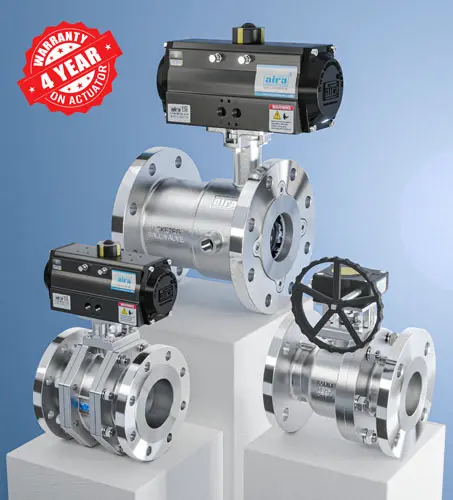
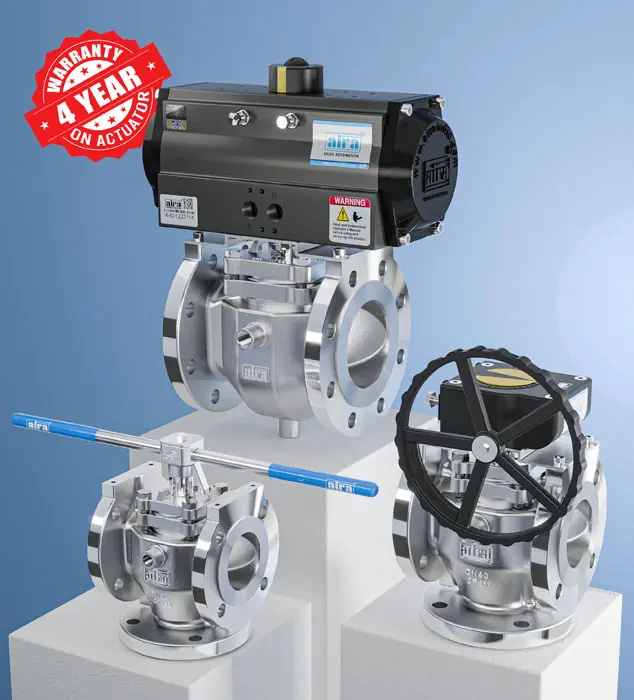
A ball valve uses a rotating, perforated ball inside the body to open or block flow with a quarter-turn (90°) motion. That’s the short version — for a full breakdown of construction, types (floating, trunnion, V-port, reduced- or full-bore), and material options, see our ball valve range. If you’re specifically comparing pneumatically actuated variants, our post on 6 types of pneumatic actuated ball valves covers the basics. This guide builds on that and focuses on what goes wrong and why.
How Do Ball Valves Fail? — Common Failure Modes
- Seat wear and leakage: The seats (usually PTFE, RPTFE, or metal) seal against the ball. Over repeated cycles, abrasive media, or high differential pressure, seats wear down or deform, causing internal leakage (valve doesn’t fully shut off).
- Stem seal / packing failure: The stem seal prevents external leakage where the stem exits the body. Packing degrades from temperature cycling, chemical attack, or simply age — showing up as visible leakage around the stem, especially after actuation.
- Ball surface damage: Erosive media, entrained solids, or slurry service can scratch or pit the ball surface. Once the ball surface is damaged, it can no longer form a clean seal against the seats, even if the seats themselves are fine.
- Actuator/stem misalignment: On pneumatically actuated valves, coupling misalignment between the pneumatic actuator and stem causes uneven torque distribution, accelerating stem seal wear and sometimes leading to incomplete valve travel. Getting actuator sizing and type right at the selection stage goes a long way in preventing this — see our guide on types of pneumatic actuators and their applications if you’re specifying one.
- Torque seizure (“stuck valve”): In valves left in one position for extended periods (common in isolation/emergency shutoff service), deposits can build up between the ball and seat, causing the valve to seize and require excessive torque to operate — sometimes exceeding actuator capacity.
- Cavitation and erosion damage: In throttling service (which standard ball valves aren’t ideally suited for), high-velocity flow through a partially open valve can cause cavitation, eroding the ball and seat surfaces over time.
Diagnostic Table: Symptom → Cause → Fix
| Symptom | Likely Cause | Fix |
|---|---|---|
| Valve leaks when fully closed | Worn/damaged seats or ball surface | Inspect seats and ball; replace seats, polish or replace ball if scored |
| Leakage around stem | Degraded packing/stem seal | Replace stem seal; check packing gland torque |
| Valve requires excessive force/torque to operate | Deposit buildup, seized ball, or actuator undersized | Cycle valve periodically in idle service; check actuator torque margin |
| Valve doesn’t fully open/close | Actuator-stem misalignment, or actuator torque insufficient | Check coupling alignment; re-verify actuator sizing |
| Erosion/pitting visible on ball or seat | Cavitation from throttling duty, or abrasive media | Avoid partial-open service on standard ball valves; consider a control/drum valve for throttling applications |
| Valve fails shortly after installation | Incorrect flow direction (on directional valves), or installation misalignment | Confirm flow direction marking; check pipe alignment and gasket seating |
Does a Ball Valve Reduce Flow?
It depends on the bore type:
- Full bore ball valves have a ball bore matching the pipe’s internal diameter, so flow resistance is minimal — close to a straight piece of pipe when fully open.
- Reduced bore (standard port) ball valves have a smaller ball bore than the pipe, which introduces some flow restriction and a modest pressure drop — acceptable for most on/off isolation duty but a factor worth checking in high-flow applications.
- V-port ball valves are a special case — designed intentionally for throttling, with a V-shaped notch in the ball that changes flow area progressively with rotation, rather than acting purely as a full-open/full-shut device.
Standard ball valves (full or reduced bore) are built for isolation, not for fine-tuned flow control. Using one for sustained throttling duty is a common cause of the cavitation-related wear described above. If you’re deciding between valve types at the specification stage rather than troubleshooting an existing one, our comparisons on ball vs. butterfly vs. control valves and needle valve vs. ball valve may help.
Does a Ball Valve Have a Flow Direction?
Most standard two-piece and three-piece ball valves are bidirectional — they seal effectively regardless of which side the flow enters from, because both seats provide sealing against the ball.
However, flow direction does matter in a few specific cases:
- Valves with a single upstream seat design (sometimes used in certain trunnion-mounted or metal-seated valves) are engineered to seal in one direction only, and installing them backward can compromise shutoff performance.
- Valves with an integral check function or a spring-loaded seat design are directional by design.
- Valves with an actuator-mounted flow arrow or manufacturer flow-direction marking should always be installed as marked, even if the internal design is technically bidirectional — the marking often reflects a tested/certified orientation.
How to Identify Flow Direction on an Unmarked Valve
If a valve arrives without a visible flow arrow:
- Check the body casting — many manufacturers cast a small arrow or “IN”/”OUT” marking directly into the valve body, sometimes obscured by paint or coating.
- Check the datasheet/nameplate — directional valves are almost always documented as such in the manufacturer’s technical data.
- When in doubt, treat it as bidirectional-safe orientation — align the valve with any existing pipeline flow arrows, and confirm with the manufacturer before installing in a critical application.
- For trunnion-mounted or metal-seated valves specifically, always confirm with the manufacturer — these designs are more likely to have a directional dependency than standard floating-ball valves.
Installation Mistakes That Cause Premature Failure
- Over-torquing the actuator during commissioning — stresses the stem seal before the valve has even entered service.
- Skipping line flushing before installation — leaves debris in the line that scores the ball surface within the first few cycles.
- Ignoring pipe support near the valve — pipe strain transmitted to the valve body can distort the seat-ball seal geometry.
- Using the valve for throttling when it was specified for isolation only — the single largest cause of early ball/seat erosion in standard ball valves.
- Mismatched gasket/flange alignment — causes uneven loading on the valve body, sometimes mistaken for a valve defect.
These issues aren’t unique to ball valves — for a broader look at how selection mistakes cause downstream problems, see valve selection mistakes plant engineers make and pipeline shut-off selection mistakes.
You May Also Like to Read:
Choosing the right ball valve for your application? Browse specifications, bore types, and materials on our ball valve range.
FAQs
Q: Can a leaking ball valve be repaired, or does it need replacement?
A: Most ball valves are repairable — seats, seals, and sometimes the ball itself can be replaced without replacing the whole valve, provided the body isn’t damaged. Whether repair is cost-effective depends on valve size and service criticality.
Q: How long should a ball valve last before failure?
A: This varies widely by service — clean fluid, infrequent-cycling isolation duty can last 10+ years, while abrasive slurry or high-cycle throttling duty may require seat/seal replacement within 1-2 years. Condition-based inspection is more reliable than assuming a fixed lifespan.
Q: Is it safe to use a standard ball valve for throttling if I only partially open it occasionally?
A: Occasional partial opening for brief periods is generally low-risk, but sustained partial-open operation accelerates seat and ball wear through cavitation and should be avoided — use a valve designed for modulating control instead.
Q: Does installing a bidirectional ball valve backward cause any problems?
A: For genuinely bidirectional valves, no — but it’s still good practice to follow any flow arrow present, since it may reflect the tested certification orientation even on a bidirectional design.