At Aira Euro Automation, we manufacture Single Piece Ball Valves in different pressure classes, end connections, and construction configurations for industrial pipeline applications. Our range includes standard flanged-end, jacketed flanged-end, and screwed-end designs.
We offer selected flanged configurations in Class 150 and Class 300, along with jacketed variants and screwed-end models. Available sizes, materials, and seat options vary according to the selected product.
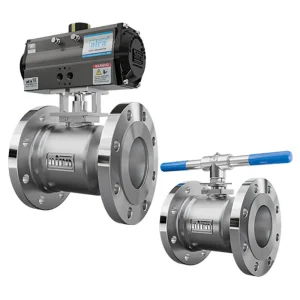
Our Class 150 Single Piece Flanged End Ball Valve is available in sizes from 1/2″ to 6″. It is offered with different body, ball, stem, and seat material options to suit industrial process requirements.
The design specifications include ASME B16.34 and BS EN ISO 17292, with ASME B16.10 face-to-face dimensions and inspection and testing references to API 598, ISO 5208 and BS EN 12266-1.
For applications requiring a higher pressure class, we manufacture Single Piece Flanged End Ball Valves in Class 300. The supplied size range is 1/2″ to 6″, with ASME B16.5 Class 300 flanged connections.
The configuration offers different body, ball, and stem material options. Seat selection depends on the selected construction and operating requirements.
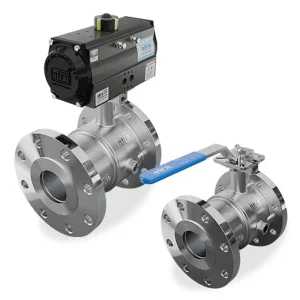
Our Class 150 Jacketed Flanged End Ball Valve is available in sizes from 1/2″ to 12″. It combines a flanged valve configuration with a jacketed construction for applications where thermal management around the valve body is required.
Available material options include different body, ball, stem, and seat combinations. PEEK seating is not available for this configuration.
We also offer a Class 300 Jacketed Flanged End Ball Valve in sizes from 3/4″ to 6″. This configuration provides a jacketed construction with Class 300 flanged connections.
Material selection depends on the process requirements and selected valve construction. PEEK seats are not available for this model.
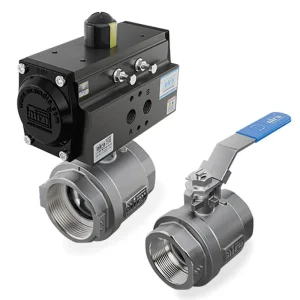
Our Single Piece Screwed End Ball Valve is designed for smaller pipeline connections and is available in sizes from 1/4″ to 2″, Class 150.
The listed end connection options include BSPT, BSP, NPT, and socket-weld connections. Body, ball, stem, and seat material options are available according to the selected configuration.
A Single Piece Ball Valve uses a rotating ball with a central bore to control the flow of media through a pipeline. The stem transfers movement from the operating mechanism to the ball.
When the ball’s bore aligns with the pipeline, the valve allows media to pass through. A quarter-turn rotation places the solid section of the ball across the flow path, closing the valve. The selected seat material provides the sealing interface around the ball.
The valve’s body construction, connection type, pressure class, and material combination should be selected according to the pipeline design and operating conditions.
Our Single Piece Ball Valves are available in different sizes, pressure classes, and material combinations. The following specifications are based on the respective product configurations.
| Product configuration | Size range | Pressure class |
|---|---|---|
| Flanged End | 1/2″ to 6″ | 150# |
| Flanged End | 1/2″ to 6″ | 300# |
| Jacketed Flanged End | 1/2″ to 12″ | 150# |
| Jacketed Flanged End | 3/4″ to 6″ | 300# |
| Screwed End | 1/4″ to 2″ | 150# |
We offer different material options to meet varying process media and operating requirements.
| Component | Available material options |
|---|---|
| Body | Cast Iron, Ductile Iron, S.G. Iron, WCB, CF8, CF8M, CF3M, SS 304L, Duplex, Hastelloy and Monel |
| Ball | CF8, CF8M, WCB with ENP, Hastelloy, Duplex, Monel and CF3M |
| Stem | AISI 410, SS 304, SS 316, SS 304L, SS 316L, Duplex 2205, Duplex 2507 and Monel |
Available seat materials vary by product configuration.
The listed temperature limits depend on the seat material and selected valve configuration.
| Seat material | Listed temperature limit |
|---|---|
| PTFE | Up to 180°C |
| RPTFE / TFM | Up to 220°C |
| PEEK | Up to 250°C |
These temperature limits are listed for applicable configurations. Jacketed models have a specific limitation: PEEK seats are not available.
Our product specifications reference the following standards for applicable configurations:
| Requirement | Referenced standards |
|---|---|
| Design and manufacture | ASME B16.34, BS EN ISO 17292 |
| Face-to-face dimensions | ASME B16.10 |
| Inspection and testing | API 598, ISO 5208, BS EN 12266-1 |
| Flange drilling | ASME B16.5, with DIN and JIS options listed for applicable models |
| Leakage requirements | ISO 5208 Class VI, ANSI/FCI 70-2 and ASME B16.104 |
POD certification is listed for all five configurations.
Aira’s Single Piece Ball Valves are manufactured for industrial pipeline services involving compatible process media and operating conditions.
Typical application areas include:
The jacketed configurations can be considered for applications requiring thermal management around the valve body. The jacket connection and heating or cooling medium should be confirmed for the selected model.
At Aira Euro Automation, we manufacture industrial ball valves for different pipeline configurations and operating requirements.
Discuss your pipeline requirements with Aira Euro Automation. Our team can help you review the available Single Piece Ball Valve configurations, pressure classes, end connections, and material options for your application.
Sales Enquiries
Phone: +91 90994 77256
Email: mkt@airaindia.com
Export Enquiries
Phone: +91 63570 57600
Email: export@airaindia.com
Technical Support – WhatsApp
+91 70436 82683
With excellent quality control, precision engineering, and exceptional after-sales support, Aira Euro delivers a long-lasting, high-performance single-piece ball valve to keep your operations running smoothly. We also make high quality 3 piece ball valves. Browse our wide range.
A Single Piece Ball Valve is a ball valve constructed with a one-piece main body. It uses a rotating ball with a bore to control the flow of media through a pipeline.
The main difference is the body construction. A Single Piece Ball Valve has a one-piece main body, whereas a Two Piece Ball Valve uses two main body sections assembled together. The suitable design depends on the installation, maintenance and application requirements.
Our supplied product range includes standard flanged-end, jacketed flanged-end and screwed-end configurations. Flanged and jacketed models are available in selected Class 150 and Class 300 configurations, while the screwed-end model is listed in Class 150.
The supplied size ranges vary by model. Standard flanged models are available from 1/2″ to 6″, jacketed configurations cover 1/2″ to 12″ or 3/4″ to 6″, and screwed-end models cover 1/4″ to 2″.
Our supplied product range includes Class 150 and Class 300 configurations. The applicable pressure class depends on the selected model and size.
A jacketed ball valve has an additional jacket around the valve body. This construction is used in applications where temperature management around the valve is required. The jacket connection and heating or cooling medium should be confirmed for the selected design.
No. The supplied specifications explicitly state that PEEK seats are not possible in both the Class 150 and Class 300 jacketed configurations.
The supplied configurations include flanged and screwed-end connections. The screwed-end model lists BSPT, BSP, NPT and socket-weld options.
Depending on the selected configuration, body material options include Cast Iron, Ductile Iron, S.G. Iron, WCB, CF8, CF8M, CF3M, SS 304L, Duplex, Hastelloy and Monel.
Seat options vary by model and include PTFE, RPTFE, CFT, GFT, Modified PTFE, AIRA-250, Nylon, Devlon and PEEK where applicable. PEEK seating is not available in the supplied jacketed configurations.
The supplied specifications list PTFE up to 180°C, RPTFE/TFM up to 220°C and PEEK up to 250°C for applicable configurations. Actual selection depends on the valve model and seat material.
The supplied specifications reference ASME B16.34 and BS EN ISO 17292 for design, ASME B16.10 for applicable face-to-face dimensions, and API 598, ISO 5208 and BS EN 12266-1 for inspection and testing.
The supplied specifications list air, water, oil and gas. Suitability depends on the media composition and compatibility with the selected body and seat materials.
POD certification is listed in the supplied specifications for all five product configurations. Product documentation should be matched to the selected model.


