
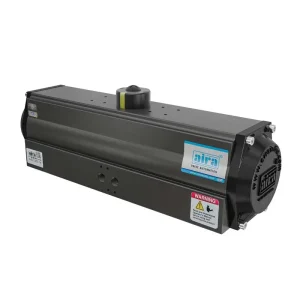
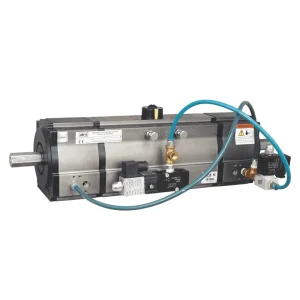
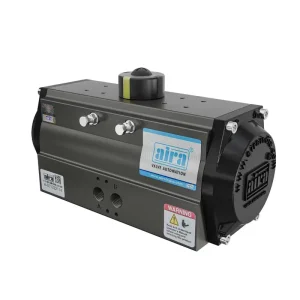
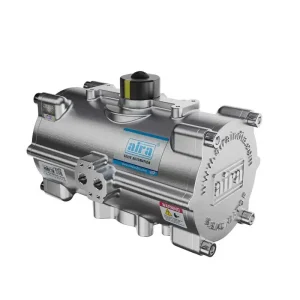
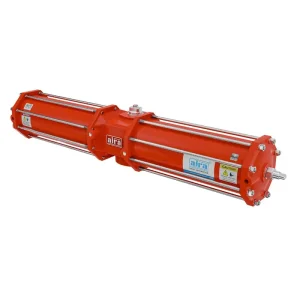
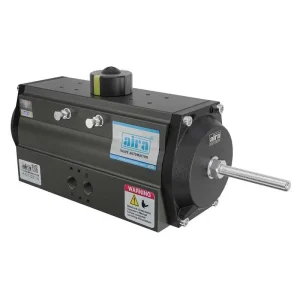
Our range includes rack-and-pinion, Scotch Yoke, 180° rotation, three-position and adjustable travel stopper actuators. These solutions are designed for applications requiring compressed-air-powered movement in both directions, with different configurations available to meet specific valve operating requirements.
A double acting pneumatic actuator is a device that converts compressed air energy into mechanical movement. It uses air pressure to drive the actuator in both directions, providing powered opening and closing movement without relying on a return spring.
Double acting actuators are commonly used for automated ball valves, butterfly valves and other compatible rotary valve assemblies. Depending on the mechanism and configuration, they can provide quarter-turn, 180° or multi-position operation.
A double acting pneumatic actuator operates through two air chambers. Compressed air enters one chamber and moves the piston or pistons, rotating the output shaft in one direction. A directional control valve then redirects the air supply to the opposite chamber, moving the pistons in reverse and rotating the shaft in the opposite direction.
The actuator uses compressed air for both strokes. This arrangement provides powered movement during opening and closing, making it suitable for automated processes that require controlled operation in both directions.
In rack-and-pinion actuators, linear piston movement is converted into rotary movement through a rack-and-pinion mechanism. In Scotch Yoke actuators, the Scotch Yoke mechanism converts piston movement into rotary output with a different torque delivery characteristic.
Aira offers different actuator mechanisms and configurations for varying torque, pressure and valve automation requirements.
| Actuator Type | Operating Pressure | Temperature Range | Construction / Mechanism |
|---|---|---|---|
| Rack & Pinion Aluminium | 3–8 bar | −20°C to +90°C | Hard-anodized aluminium body; rack and pinion |
| Rack & Pinion Stainless Steel | 2–8 bar | −20°C to +80°C standard | Stainless steel construction; rack and pinion |
| 180° Rotation | 3–8 bar | −20°C to +90°C | Rack and pinion; 180° rotation |
| 3 Position | 35–150 PSI | −20°C to +90°C | ARA-55D to ARA-210D size range |
| Scotch Yoke | 3–7 bar | −25°C to +90°C | Heavy-duty Scotch Yoke mechanism |
| Adjustable Travel Stopper | 4–8 bar | −20°C to +90°C | Aluminium body; rack and pinion; adjustable travel |
Aira’s double acting pneumatic actuators offer torque output ranging from 3.6 Nm to 116,984 Nm, across different actuator models and operating pressure conditions. The range includes compact rack-and-pinion actuators for lower torque requirements and heavy-duty Scotch Yoke actuators for high-torque industrial valve applications.
The aluminium rack-and-pinion and stainless steel actuator ranges also provide model-wise air consumption data. Actual torque output and air consumption depend on the selected actuator model and operating air pressure. Refer to the respective torque and air consumption charts for accurate actuator sizing.
Our rack-and-pinion double acting actuators feature ISO 5211 valve mounting and NAMUR-standard accessory interfaces, as specified for the respective models. These interfaces support the installation of compatible valves, limit switches, positioners and other pneumatic accessories.
For specialised configurations, mounting dimensions and accessory compatibility should be checked against the respective actuator model drawing.
Aira manufactures different double acting actuator configurations to address specific valve automation requirements.
Our 180° rotation actuator is designed for applications requiring a full 180-degree output movement. It is suitable for compatible multi-way valve arrangements, including 3-way valves, where ON/OFF operation requires an extended rotation angle.
The 3 Position Pneumatic Actuator provides two end positions and an adjustable intermediate position. Available in sizes from ARA-55D to ARA-210D, it operates within a temperature range of −20°C to +90°C and a working pressure range of 35–150 PSI. It is suitable for applications requiring intermediate positioning, including coarse and fine adjustment.
This actuator features a hard-anodized aluminium body and a rack-and-pinion mechanism for rotary valve operation. Its design includes replaceable sliding skates, adjustable travel stops and ISO 5211 valve mounting. Model-wise torque and air consumption data are available for selection.
Our stainless steel rack-and-pinion actuator is designed for applications where corrosion resistance and material selection are important. Its construction includes SS304 and SS316 components, with model-wise torque data available across different air pressures.
The Scotch Yoke actuator uses a heavy-duty yoke mechanism to convert linear piston movement into rotary output. Aira’s SAY series covers a broad torque range, with listed models from 515 Nm to 116,984 Nm under specified operating conditions. It is designed for demanding quarter-turn valve applications.
This actuator combines a rack-and-pinion mechanism with an adjustable travel stopper arrangement. It is designed for applications requiring adjustment of the actuator’s output travel. The available range includes ARA-50 to ARA-210 models, with an operating pressure of 4–8 bar and a temperature range of −20°C to +90°C.
Double acting pneumatic actuators are used in industrial processes where automated valves require powered movement in both directions.
Common applications include:
The correct actuator configuration depends on valve type, operating torque, required rotation, air pressure, process conditions and control requirements.
Selecting an actuator requires matching its output torque and operating characteristics with the valve’s requirements.
Determine the valve torque requirement
Identify the valve’s required operating torque from its manufacturer or technical documentation. Consider the torque requirements throughout the complete opening and closing cycle, not just the breakaway value.
Check the available air pressure
Confirm the minimum and normal operating air pressure available at the actuator. Use the torque chart for the specific actuator model and pressure to establish its available output torque.
Apply an appropriate safety factor
Include an appropriate safety margin based on the valve design, service conditions and project requirements. The required margin should be established using the valve manufacturer’s recommendations and engineering specifications.
Select the operating mechanism
Choose rack and pinion or Scotch Yoke based on the torque requirement and actuator application. For specialised requirements, consider 180° rotation, three-position operation or adjustable travel stopper configurations.
Verify mounting and accessories
Check the valve mounting dimensions, shaft or stem connection, NAMUR interface and compatibility with required accessories such as limit switches, positioners and solenoid valves.
Consider operating conditions
Evaluate temperature, moisture, corrosion exposure, air quality and hazardous-area requirements before finalising the actuator material and configuration.
For assistance with actuator sizing, share the valve torque, operating pressure, valve type and application details with our technical team.
Both actuator types use compressed air, but their return movement and air-failure behaviour are different.
| Parameter | Double Acting Actuator | Single Acting Actuator |
|---|---|---|
| Opening movement | Compressed air | Compressed air |
| Closing / return movement | Compressed air | Spring force |
| Return spring | Not required | Required |
| Movement in both directions | Pneumatically powered | Air-powered in one direction, spring-powered in the other |
| Air supply failure | No automatic spring-return action | Moves towards its designed spring-fail position |
| Typical selection | Applications requiring powered movement in both directions | Applications requiring spring-return fail action |
Choose a double acting actuator when powered movement is required in both directions. Select a single acting actuator when the valve must move towards a defined spring-fail position following loss of air supply.
Explore our Single Acting Pneumatic Actuators for spring-return configurations.
Aira Euro Automation combines actuator manufacturing, engineering capabilities and product support to serve industrial valve automation requirements.
For Customer Technical Support on WhatsApp: +91 70436 82683
Visit our Certifications & Approvals page to review available certification documentation.
Ready to automate your valve operations? Connect with Aira’s technical team today to identify the right double acting pneumatic actuator for your application.
Share your valve details, required torque and operating pressure. Get expert assistance with actuator selection, technical specifications and pricing.
For Sales Enquiries
Call: +91 90994 77256
Email: mkt@airaindia.com
For Export Enquiries
Call: +91 63570 57600
Email: export@airaindia.com
Explore our Pneumatic Actuator Range or contact us to discuss your requirements.
A double acting actuator uses compressed air for movement in both directions. A single acting actuator uses compressed air for one movement and a spring for the return movement.
The required pressure depends on the actuator model. Aira’s product ranges include different operating pressures, such as 3–8 bar for aluminium rack-and-pinion actuators, 2–8 bar for stainless steel actuators and 3–7 bar for the listed Scotch Yoke series.
Start with the valve manufacturer’s operating torque data. Consider breakaway, running and seating torque requirements, then apply the appropriate engineering safety factor. Match the resulting requirement with the actuator torque chart at the available air pressure.
Yes. Double acting pneumatic actuators can automate compatible ball and butterfly valves. The actuator must be selected according to the valve’s torque requirements, mounting dimensions and operating conditions.
A Scotch Yoke actuator is used for rotary valve automation where its torque delivery characteristics suit the valve’s operating requirements. Aira’s SAY series is designed for heavy-duty quarter-turn applications.
A 3 position pneumatic actuator provides two end positions and an adjustable intermediate position. Aira’s range covers sizes from ARA-55D to ARA-210D, with working pressure of 35–150 PSI and a temperature range of −20°C to +90°C.
A standard double acting actuator does not have an automatic spring-return mechanism. Its position after air failure depends on the valve load, actuator design and control system. Applications requiring a defined spring-fail position should consider a suitable single acting actuator.
Consider the operating environment, corrosion exposure, process conditions and material compatibility. Aluminium rack-and-pinion actuators are available for general industrial automation, while stainless steel construction can be selected for applications requiring greater corrosion resistance.


