
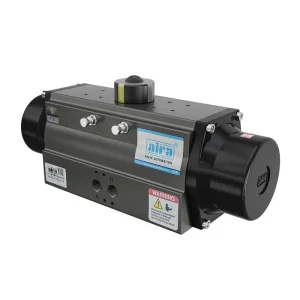
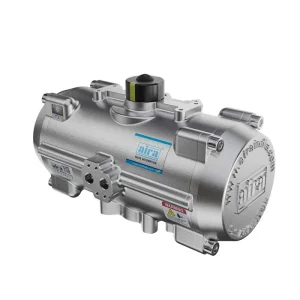
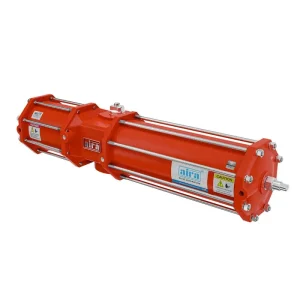
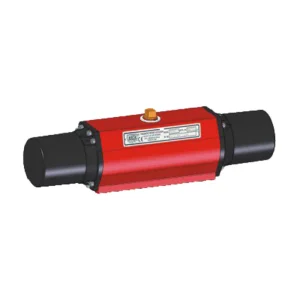
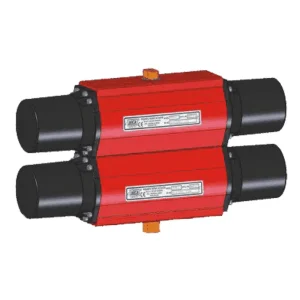
We ensure precise craftsmanship and consistent reliability in every actuator we produce. What truly sets us apart is our industry-leading 4-year warranty on all single acting pneumatic actuators—a feature no other manufacturer in India offers. Designed to deliver unmatched performance and durability, Aira Euro’s actuators are trusted by industries worldwide. Whether you need precision, reliability, or long-lasting operation, our actuators are the perfect choice for your automation requirements.
The Single Acting Pneumatic Actuator utilizes compressed air to operate valves efficiently. Air pressure moves the pistons to generate torque, rotating the actuator shaft and controlling the connected valve. When air is released, a spring mechanism automatically returns the actuator to its original position, ensuring a fail-safe operation. This makes it an ideal choice for applications requiring enhanced safety and reliability. Our actuators are designed for precision, offering smooth and consistent performance over prolonged use. With features like a hard-anodized body, sliding skates, and ISO-standard mounting, Aira Euro’s actuators ensure flawless operation in even the most demanding environments.
Choosing Aira Euro means choosing excellence. Our Single Acting Pneumatic Actuators are designed with advanced features that enhance both performance and durability. The hard-anodized barrel ensures resistance to corrosion, while the sliding skates reduce friction and extend lifespan. Our actuators are also equipped with ISO-5211 standard mounting and Namur standard pinion tops, offering superior flexibility and compatibility.
Beyond features, what makes us truly unique is our 4-year warranty—an assurance of the quality and reliability of our products. No other manufacturer in India offers this level of confidence in their pneumatic actuators. Additionally, with complete in-house manufacturing, we ensure every actuator is built to the highest standards. Whether you need a Single Acting Pneumatic Actuator or want to explore our range of Double Acting Pneumatic Actuators, Aira Euro provides solutions you can trust.
Get the right spring-return actuator for your valve application. Contact Aira Euro Automation with your valve type, required torque, available air pressure, and fail-open or fail-close requirement. Our team will assist with actuator selection, technical details, and pricing.
For Sales Assistance
Phone: +91 90994 77256
Email: mkt@airaindia.com
For Export Inquiries
Phone: +91 63570 57600
Email: export@airaindia.com
For Customer Technical Support
WhatsApp: +91 70436 82683
1. What is a Single Acting Pneumatic Actuator?
A Single Acting Pneumatic Actuator uses compressed air to move its pistons in one direction and an internal spring to produce the return movement. It is commonly used for automated valves that require a defined spring-return position.
2. How does a Single Acting Spring Return Pneumatic Actuator work?
When compressed air enters the actuator, the pistons move against the internal spring force and rotate the output shaft. When the air is exhausted, the spring pushes the pistons back and rotates the shaft in the opposite direction.
3. What is the difference between spring-to-open and spring-to-close actuators?
A spring-to-open actuator moves the connected valve towards its open position when the air supply is exhausted. A spring-to-close actuator moves the valve towards its closed position. The required arrangement depends on the process safety requirements and valve configuration.
4. What happens when the compressed air supply fails?
When the air supply is lost and the actuator’s air chamber is exhausted through the control system, the internal spring drives the actuator towards its designed fail position. The final valve position depends on whether the actuator is configured for spring-to-open or spring-to-close operation.
5. What is the difference between pneumatic torque and spring torque?
Pneumatic torque is the output torque generated when compressed air moves the actuator pistons against the spring force. Spring torque is generated by the internal spring as it returns the actuator towards its original position. Both values must be considered when selecting a single acting actuator.
6. How do I select the correct torque for a Single Acting Pneumatic Actuator?
First, obtain the valve’s breakaway, running and seating torque requirements. Then identify the available air pressure and required spring-return direction. Compare the valve torque requirements with the actuator’s pneumatic torque and spring torque charts at the selected pressure and spring setting. Include the appropriate safety factor based on the valve and process conditions.
7. What operating pressure is required for a Single Acting Pneumatic Actuator?
The required pressure depends on the actuator model. Aira’s listed ranges include 3–8 bar for aluminium rack-and-pinion actuators, 4–8 bar for stainless steel and Double Decker models, and 4–7 bar for the SAY-SA Scotch Yoke series. The SYS aluminium Scotch Yoke range is specified at 35–150 PSI.
8. Which valves can be operated using Single Acting Pneumatic Actuators?
Single acting pneumatic actuators can operate compatible quarter-turn ball valves, butterfly valves and plug valves. Scotch Yoke models can also be used for compatible dampers. Selection depends on the valve’s torque requirement, shaft connection, mounting dimensions and required fail position.
9. What is the difference between Single Acting and Double Acting Pneumatic Actuators?
A single acting actuator uses compressed air for one movement and an internal spring for the return movement. A double acting actuator uses compressed air for both directions and does not rely on a return spring. Single acting actuators are selected when spring-return action is required, while double acting actuators are used when powered movement is needed in both directions.
10. How do I choose between aluminium and stainless steel single acting actuators?
Consider the process environment, corrosion exposure, material compatibility and operating conditions. Aluminium actuators are suitable for many general industrial applications, while stainless steel construction is useful in environments exposed to corrosive chemicals, moisture and demanding process conditions.
11. What is the difference between Rack & Pinion and Scotch Yoke Single Acting Actuators?
Rack-and-pinion actuators use pistons with racks to rotate a central pinion shaft. Scotch Yoke actuators use a yoke mechanism to convert linear piston movement into rotary output. Their torque characteristics differ throughout the rotation cycle, so the selection should be based on the valve’s torque profile and actuator torque charts.
12. How do I select the correct actuator size for my valve?
Start with the valve manufacturer’s torque data, available air pressure, and required fail action. Select an actuator model whose pneumatic torque and spring torque satisfy the valve’s requirements throughout the operating cycle, including the required safety margin. Also verify mounting dimensions, rotation angle, and accessory compatibility.
13. Can a Single Acting Pneumatic Actuator be configured for fail-open and fail-close operation?
Yes. Depending on the actuator design, spring arrangement and installation orientation, the actuator can be configured for fail-open or fail-close operation. Certain Scotch Yoke configurations also provide fail-clockwise and fail-counter-clockwise arrangements. Confirm the required direction with the actuator manufacturer before ordering.
14. What maintenance does a Single Acting Pneumatic Actuator require?
Inspect the actuator periodically for air leakage, seal condition, mounting tightness and smooth operation. For spring-return models, inspect the spring mechanism according to the manufacturer’s maintenance instructions. If spring replacement is required, follow the prescribed procedure and replace springs as a complete matched set where specified.


