
How Does a Pressure Reducing Valve Work?
A pressure reducing valve (PRV) is a self-operating valve designed to reduce high inlet pressure to a stable, lower outlet pressure, ensuring safe and efficient system operation. It automatically maintains the desired downstream pressure under both flowing and non-flowing conditions, often referred to as “tight shut-off” or “drop-tight” control.
The working principle of a pressure reducing valve is based on balancing forces. When the outlet pressure increases beyond the set limit, the diaphragm inside the valve moves upward, causing the internal poppet or seat to restrict the flow passage. This reduces the flow rate and brings the pressure back to the desired level. Conversely, when the outlet pressure drops, the valve opens to allow more flow, maintaining consistent pressure.
Pressure reducing valves are widely used in water supply systems, steam lines, oil and gas pipelines, and compressed air systems. In hydraulic systems, they are commonly referred to as pressure reducing valves, while in pneumatic systems, they are often called pressure regulators.
These valves are typically manufactured using durable materials such as stainless steel, brass, plastic, and aluminum, making them suitable for a wide range of industrial and residential applications. Their primary function is to control and stabilize outlet pressure, protecting equipment, reducing water consumption, and improving overall system efficiency.
Components in Pilot Operated Pressure Reducing Valve
The Pilot Operated Valve components are made of Brass, stainless steel, Plastic, and aluminum.
A pressure reducing valve consists of key components such as an adjusting screw, adjusting spring, conical poppet, diaphragm, inlet port, outlet port, and an orifice, all working together to regulate and maintain consistent downstream pressure.
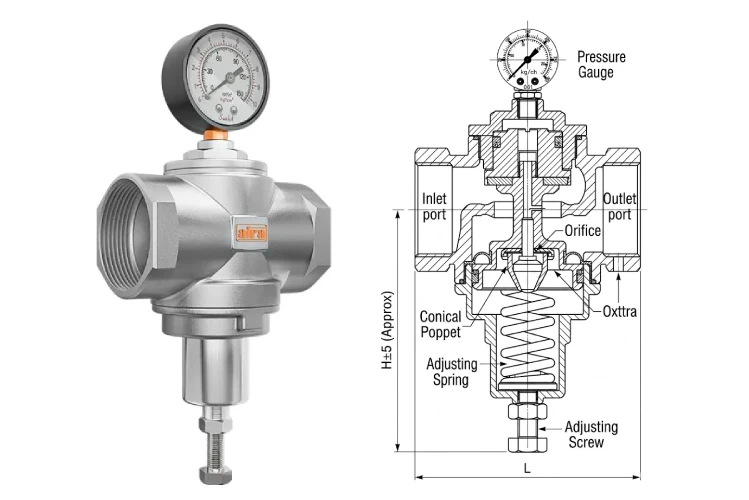
- Adjustable Screw: The adjustable screw rotates, allowing the springs to move and adjust the pressure limit.
- Adjusting Spring: The adjusting spring is connected to the screw. When the screw rotates, it allows the spring to move and set the pressure of flow.
- Conical poppet: The conical poppet is fitted to the diaphragm. It works to open/close the working way of the flow.
- Diaphragm: The diaphragm is a pressure-responsive component that works as a control disk to control and obstruct the passageway of media.
- Inlet port: This component is connected to the pump. The flow of media comes into the valve from the inlet port.
- Outlet port: The outlet port is connected to the system. Where the flow of media goes out to the system. The valve can have more outlet ports according to the applications.
- Orifice: The orifice connects the inlet and outlet ports. The passageway of media is known as an orifice.
Types of Pressure Reducing Valve
There are two types of Pressure Reducing Valves:
- Direct Acting Pressure Reducing Valve.
- Pilot-Operated Pressure Reducing Valve.
Direct Acting Pressure Reducing Valve
The Direct Acting Pressure Reducing Valves are excellent for small loads type applications. They are constructed in a compact size and are easy to install. They are utilized in many sectors, such as the Industrial, Building, Food & Beverage, and Water sectors, generally used in gas and liquid systems. It protects the other elements of the system from high-pressure damage. It does not require any external energy to operate as it is self-contained.
Pilot Operated Pressure Reducing Valve
Aira’s Pilot-Operated Pressure Reducing Valves are commonly used for larger loads of applications. They are larger in size and costly. It uses a pilot valve to load a diaphragm that increases the force. In larger flow applications, it helps to increase the low-pressure variation. Pilot operated valve controls the opening and closing by balancing the force of the adjustment spring and pressure. It delivers the pressure to the diaphragm. The downward force of pilot operated valve is amplified by the area of the diaphragm, which enables the opening of a larger main valve, providing the ability for a high flow pressure rate.
Is the Pressure Reducing Valve worth it?
In High water pressure application operation, water comes down from the mountains or high rise water tanks. Water PRV reduces the water pressure and helps to protect pipes and fixtures from damage or breaks/leakages. PRV is best, as it saves money by reducing the amount of wasted water in your home. Water is a primary need of the environment. Most people think about pressure-reducing valves as Pressure control causes, as described above; they are engineered to protect applications and piping from the effects of high water pressure. Water Pressure Reducing Valves have been supreme because they automatically control the pressure and provide the advantage of preserving water and energy. Hence, the Pressure Reducing Valve is well-proven for plumbing pipe damage, provides quality working for lower pressure, and conserves money and water.
Read this blog, here we discussed in detail about The Purpose of Pressure Reducing Valve
Difference Between Pressure Reducing Valve and Pressure Relief Valve
| Parameter | Pressure Reducing Valve (PRV) | Pressure Relief Valve (Safety Valve) |
|---|---|---|
| Function | Maintains a constant, reduced outlet pressure | Protects the system by releasing excess pressure |
| Purpose | Controls and stabilizes downstream pressure | Prevents overpressure conditions |
| Operation | Continuously regulates pressure during operation | Activates only when pressure exceeds a set limit |
| Valve Position | Normally open | Normally closed |
| Working Mechanism | Reduces pressure by restricting flow | Releases fluid to relieve excess pressure |
| Control Type | Can be manual or automatic (mostly automatic) | Fully automatic |
| Applications | Water systems, oil & gas, hydraulic systems | Steam systems, boilers, pressurized vessels |
| Media Compatibility | Suitable for liquids and gases | Commonly used for gases and steam systems |
| Installation Location | Installed upstream in the system | Installed downstream or at pressure-sensitive points |
5 Points you need to know if you require a Pressure Reducing Valve
- It can protect your pipes and save your fixtures. And improves efficiency.
- Prv doesn’t require any external energy.
- It can help preserve water and prevent damage.
- They are used on both heating systems and drinking water supplies.
- PRVs provide static lower pressure across a wide range of water systems.
Applications of PRVs
Pressure Reducing Valves are primarily operated in Air or Gas service, water service, and steam service.
Air and Gas service
Pneumatic control systems, control valves, compressed air systems, and power tools for industrial gas systems and distribution systems use direct-acting and pilot-operated pressure-reducing valves for air and gas services. The type of pressure-reducing valve used for these types of applications is constructed according to the requirements of the applications.
Water services
Pressure-reducing water control valves are used for fire protection systems. Direct-acting pressure-reducing valves are generally preferred for this type of application. Due to high downstream pressure, system maintenance becomes burdensome. Pressure-reducing valves effectively control the pressure and caused to save water.
Steam service
Mainly, pressure reducing valves are used in steam applications, including direct-acting steam applications, steam engines, and turbines.
Conclusion
Pressure Reducing Valves (PRVs) are automatic valves that reduce high-pressure inlet to low outlet pressure. They protect systems from damage, conserve water, and ensure efficient operations across applications such as water, steam, and gas industries. PRVs are essential for maintaining stable pressure control, making them valuable components in modern industrial and plumbing systems. Explore our range of high-pressure reducing valves or contact our experts today to find the right solution for your application.