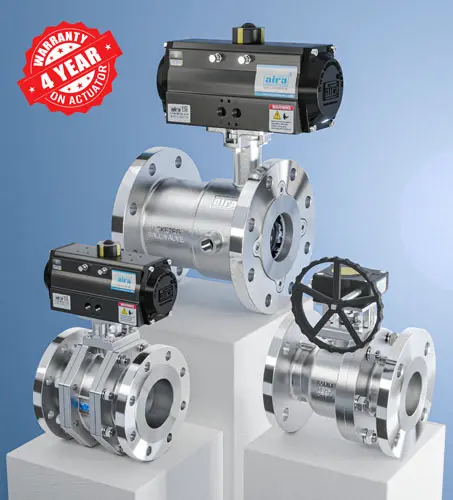
A ball valve is a quarter-turn on/off the device. The flow of liquids or gases is controlled by a pivoting ball at the center of the valve.
Pivoting balls are called rotary balls, and they are designed with holes (bores) in the center. To open or close the valve, the ball is rotated by a stem on top of the ball. Manual levers or automation can be used to turn the stem.
Construction:
A ball valve consists of a body, a spherical plug, and seats. A ball valve can be made in three general patterns:
- Venturi port,
- Full port and
- Reduced port.
– A full-port valve has an inside diameter equal to the pipe’s diameter.
-Venturi and reduced-port styles have a port that is generally one pipe size smaller than the line. The sealing of the stem is achieved with bolted packing glands and O-ring seals.
There are also valves with lubricant-seal systems similar to those for plug valves.
Ball valves are usually made from steel, iron, brass, bronze, or PVC.
you would like to read Butterfly Valve Maintanance Guide
Benefits:
- Ball valves offer several distinct advantages over other types of valves:
- Compact and economical designs
- Quick shut-off times
- High-pressure, high-volume, and high-temperature-resistant
- Less susceptible to corrosion or damage
- Longer lifespan
Perfect for a wide range of industrial applications
How Ball Valve Design Affects Valve Performance
The design of a ball valve influences its sealing performance, operating torque, pressure handling, flow characteristics, and suitability for different industrial applications. While all ball valves use a quarter-turn operating principle, their internal construction and ball support arrangement can vary significantly.
For example, floating ball valve designs use line pressure to help push the ball against the downstream seat, while trunnion-mounted designs mechanically support the ball and are commonly selected for larger sizes and higher-pressure services. V-notch ball valves are used when throttling and flow control are required, whereas lined ball valves are selected for applications involving corrosive or chemically aggressive media.
When selecting a ball valve, factors such as valve size, pressure rating, temperature, process media, required flow characteristic, sealing requirements, and operating frequency should be considered. Choosing the appropriate ball valve design can help improve reliability and reduce maintenance requirements.
Floating Ball Valve & Their Benefits:
In industrial piping systems, floating ball valves are the most common type of valve. The ball of these valves is designed in such a way that as the seats wear, the pressure from the flowing media will force the ball against the downstream seat to maintain a tight seal.
Floating ball valves are most commonly used in applications that require medium to low-pressure valves and are suitable for both liquids and gases.
Benefits:
- Convenient design
- Cost-effective
- Personalized
- Low resistance to flow
- Reliable sealing mechanisms
- Easy to assemble
Trunnion Ball Valve & Their Benefits:
In trunnion mounted ball valves, the ball is supported by a second stem opposite the operating stem, similar to floating ball valves. The second stem and bearing are called the trunnion.
The stem of a trunnion ball valve is rigidly attached to the ball, preventing the ball from moving anywhere other than on its axis. The trunnion ball valve maintains a proper seal on both sides simultaneously since the ball does not move downstream with the pressure. It is especially critical for multiport valves and valves used in very low-pressure applications where the flow of media is not strong enough to push the ball against the downstream seat.
Trunnion valves are useful in both low and high-pressure applications and require less torque to operate than floating ball valves. Despite this, piping system designers should note that trunnion ball designs are generally more expensive than floating ball designs.
Benefits:
- Lower operation cost
- Effective in both low and high-pressure situations.
- Useful for the facilitation of hydrocarbon processing
- Ball valves are fitted with spring-loaded seats
V Notch Ball Valve & Their Benefits:
- Valve with V-Notch is a quarter-turn valve ball segment.
- The V-Ball creates a wedging effect.
- The shearing action prevents stock from being dragged or sludged between the ball and its seal
- V-Notch Ball Valves are squared and clamped with a driven shaft.
Most commonly, a contoured V-port in the ball is available with an angle of 15°, 30°, 45°, 60°, or 90°, which produces an equal percentage flow characteristic. As compared to more expensive and larger control valves, V-ball valves offer a variety of benefits for flow control applications.
Benefits:
- The pressure drop is low.
- Bubble tight shut off.
- Flow control is precise.
- There is a high shut-off pressure.
Lined Ball Valve
Lined Ball Valves consist of a body, stem, ball, seat, and lining.
The interior is completely lined with high-quality PTFE or PFA lining material which, due to its thickness, completely protects the valves against chemical corrosion. It is an ideal choice for nasty applications.
Lined Ball Valves consist of a body, stem, ball, seat, and lining.
Multi Port Ball Valves & Their Benefits
It is a type of ball valve that has generally more than two ports and can be controlled in either 3, 4, or 5 ways, depending on the application. The process is typically used for selecting several flow paths to ensure the process continues according to the customer’s requirements.
Benefits:
Multi-port ball valves significantly reduce corrosion in tank installations, valve manifolds, and pipe systems.
Valves with multiple ports can be equipped with position indicators, pneumatic or electric actuators, lockouts and targets, and multiple ball structures
Designed to significantly reduce dead legs while maximizing drainage.
Ball Valve Design Applications
Different ball valve designs are used across industrial applications depending on their operating requirements.
- Oil & Gas: Floating and trunnion-mounted ball valves are used for isolation and pipeline flow control.
- Chemical Processing: Lined ball valves can be suitable where corrosion resistance is required.
- Water Treatment: Ball valves are commonly used for pipeline isolation and process equipment connections.
- Pharmaceutical & Food Processing: Suitable material and hygienic design considerations are important for process applications.
- Power Generation: Ball valves may be used in auxiliary systems and fluid handling applications.
- General Industrial Systems: Multi-port and standard ball valve designs can be used where multiple flow paths or reliable shut-off are required.
The appropriate design should always be selected according to the media, pressure, temperature, pipeline size, and required valve function.
Conclusion
We at Aira Euro automation are a leading valve manufacturer, supplier, and exporter in the India. Our Actuated Ball Valves are used for Oxygen Applications. Our corrosion-resistant ball valves have been designed by a team of expert engineers with years of experience in the field. We gained API certificates for various quality parameters. As every product has to match the standard quality guidelines because our quality department manually tests each product to ensure safety & security before delivery. Not only in the India, but we are the global supplier of industrial valves.
Choose the Right Ball Valve Design for Your Application
Selecting the right ball valve design is important for achieving reliable shut-off, efficient flow handling, and long-term performance. Whether your application requires a floating, trunnion-mounted, V-notch, lined, or multi-port ball valve, the selection should be based on the operating pressure, temperature, media, pipeline size, and required valve function.
Aira Euro Automation offers a range of industrial ball valve solutions for different process and flow-control requirements. Contact our technical team to discuss your application and identify a suitable ball valve design.
Explore our Ball Valve range or contact us for technical assistance.
Frequently Asked Questions
What is ball valve design?
Ball valve design refers to the construction and internal arrangement of a ball valve, including its body, ball, seats, stem, port configuration, and method of supporting the ball. Different designs are developed for specific pressure, flow, media, and operating requirements.
What are the main types of ball valve designs?
Common designs include floating ball valves, trunnion-mounted ball valves, V-notch ball valves, lined ball valves, and multi-port ball valves. Each design has different characteristics and application requirements.
What is the difference between floating and trunnion ball valve design?
A floating ball valve uses the pressure of the flowing media to push the ball against the downstream seat, while a trunnion-mounted ball valve uses additional mechanical support to hold the ball in position. The choice depends on factors such as valve size, pressure, torque, and application requirements.
Why is ball valve design important?
Ball valve design affects sealing performance, operating torque, flow characteristics, pressure handling, maintenance requirements, and overall suitability for a particular application.
Where are V-notch ball valves used?
V-notch ball valves are commonly used where more precise flow control is required. Their V-shaped ball opening provides a controlled flow characteristic compared with standard on/off ball valve designs.
How do I select the right ball valve design?
Consider the process media, pressure, temperature, valve size, flow requirements, operating frequency, material compatibility, and required shut-off or control performance before selecting a ball valve design.