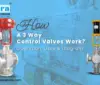
A 3 way control valve is an advanced flow control device used to mix or divert fluid within a system. Unlike standard valves that only allow or stop flow, a 3 way control valve provides precise control over fluid direction and temperature. Understanding the 3 way control valve working principle and operation is essential for applications in HVAC, water systems, and industrial processes.
These valves consist of three ports—A, B, and AB—which allow flexible flow control. Ports A and B are typically used as inlets for mixing applications, while port AB acts as the outlet. In diverting applications, port AB becomes the inlet, directing flow toward ports A or B.
3 Way Control Valve Operation
A 3 way control valve operates by regulating the direction and flow of fluid through three ports—A, B, and AB. It consists of three main components: valve body, actuator, and plug (or spindle).
The actuator (pneumatic or electric) moves the plug up and down, opening or closing specific ports to control fluid flow. This allows the valve to perform both mixing and diverting operations efficiently.
In the mixing operation, fluids enter through ports A and B and combine inside the valve before exiting through port AB. In a diverting operation, fluid enters through port AB and is directed toward either port A or port B, depending on system requirements.
Visit this blog to get in-depth details about the control valve and its working principle.
3 Way Control Valve Working Principle
The working principle of a 3 way control valve is based on controlling fluid flow through three different ports—typically labeled A, B, and AB. The valve uses an actuator to move the internal plug or spindle, which changes the flow path between these ports.
Depending on the configuration, the valve can either mix two inlet streams into one outlet or divert one inlet flow into two different outlet paths.
There are two common types:
- Mixing valve: Combines flow from ports A and B into AB
- Diverting valve: Directs flow from AB to either A or B
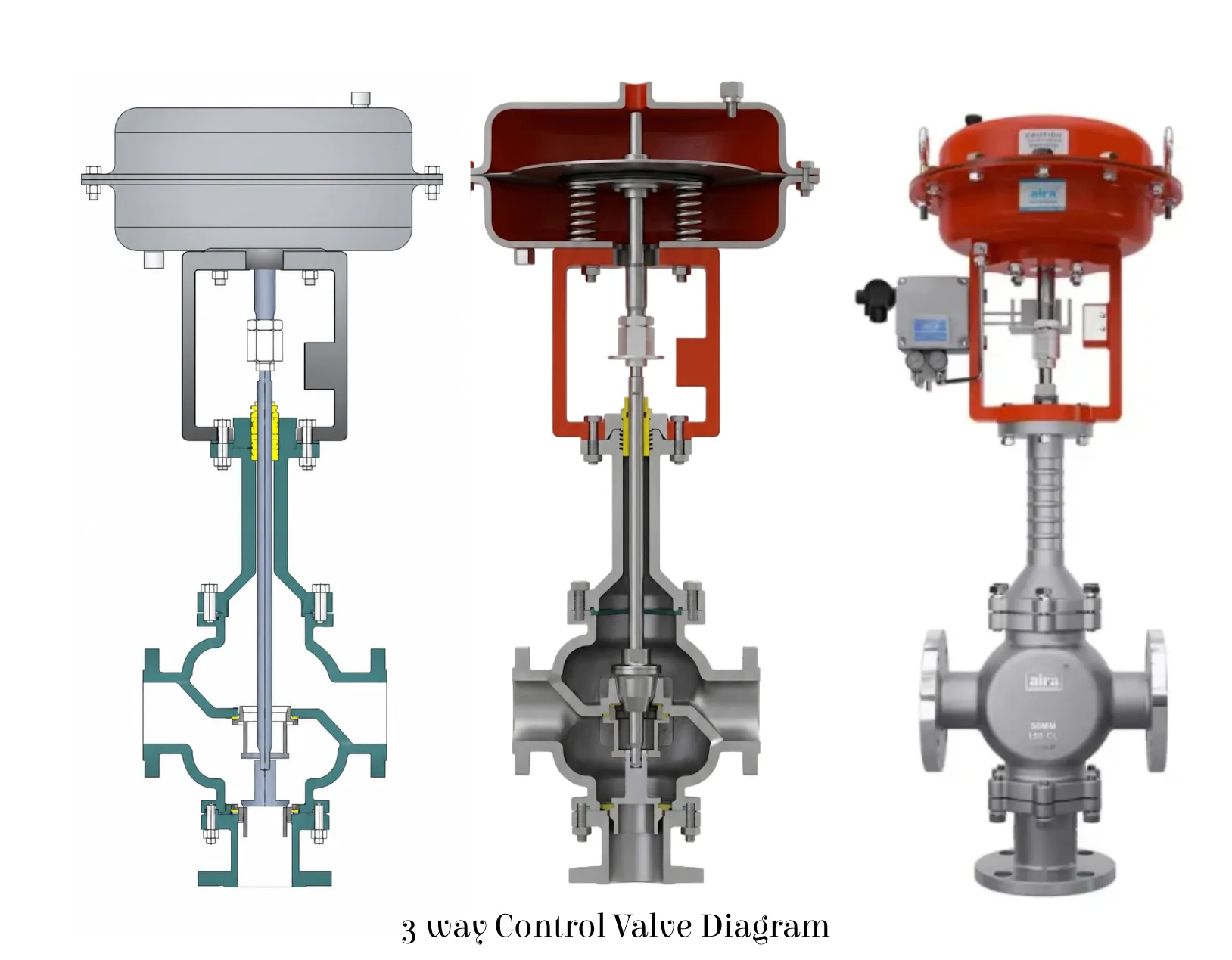
3 Way Control Valve Diagram
A typical 3 way control valve diagram shows three ports (A, B, and AB), an actuator, and an internal plug mechanism. The diagram illustrates how fluid flows in both mixing and diverting modes.
3 Way Control Valve Uses
3 way control valves are widely used in applications where fluid flow needs to be mixed or diverted efficiently. These valves reduce system complexity and improve performance.
Common uses include:
- HVAC systems (heating & cooling control)
- Hot oil systems
- Water and steam applications
- Heat exchangers
- Industrial process control systems
Industries Using 3 Way Control Valves
These valves are widely used across industries such as:
- Wood and paper industry
- Automotive manufacturing
- Food and beverage processing
- Marine applications
- Petroleum and oil & gas
- Municipal and steam systems
Aira Euro Automation is a leading manufacturer and exporter of high-quality industrial control valves in India. We offer a wide range of pneumatic control valves designed for various applications, with sizes ranging from ½” to 2½”, pressure capacity up to 42 bar, and temperature resistance up to 180°C.
Contact us today to find the right 3 way control valve solution for your application.
Frequently Asked Questions (FAQs) About 3 Way Control Valves
What is a 3 way control valve?
A 3 way control valve is used to mix or divert fluid flow using three ports—A, B, and AB.
How does a 3 way control valve work?
It uses an actuator to move an internal plug, controlling flow between ports for mixing or diverting applications.
What is the working principle of a 3 way control valve?
The valve regulates flow by adjusting the internal plug position, allowing fluid to mix or change direction.
What are the uses of a 3 way control valve?
Used in HVAC, water systems, steam applications, and industrial process control.
What is the difference between mixing and diverting valves?
Mixing combines two flows into one, while diverting splits one flow into two directions.
.faq-section {
max-width: 800px;
margin: auto;
font-family: Arial, sans-serif;
}
/* Premium Card Look */
details {
margin-bottom: 12px;
padding: 14px;
border: 1px solid #e5e5e5;
border-radius: 10px;
background: #ffffff;
box-shadow: 0 4px 10px rgba(0,0,0,0.04);
transition: all 0.3s ease;
}
details:hover {
box-shadow: 0 6px 18px rgba(0,0,0,0.08);
}
/* Question */
summary {
font-weight: 600;
font-size: 16px;
cursor: pointer;
position: relative;
list-style: none;
}
/* Remove default arrow */
summary::-webkit-details-marker {
display: none;
}
/* Custom + icon */
summary::after {
content: “+”;
position: absolute;
right: 10px;
font-size: 20px;
transition: transform 0.3s ease;
}
/* When open */
details[open] summary::after {
content: “-“;
}
/* Answer */
details p {
margin-top: 10px;
color: #444;
}
{
“@context”: “https://schema.org”,
“@type”: “FAQPage”,
“mainEntity”: [
{
“@type”: “Question”,
“name”: “What is a 3 way control valve?”,
“acceptedAnswer”: {
“@type”: “Answer”,
“text”: “A 3 way control valve is a type of control valve used to mix or divert fluid flow. It has three ports—A, B, and AB—which allow it to combine two fluid streams into one or direct one flow into different paths.”
}
},
{
“@type”: “Question”,
“name”: “How does a 3 way control valve work?”,
“acceptedAnswer”: {
“@type”: “Answer”,
“text”: “A 3 way control valve works by using an actuator to move an internal plug that controls fluid flow between three ports. Depending on the plug position, it can mix two inlet flows or divert one flow into different outlets.”
}
},
{
“@type”: “Question”,
“name”: “What is the working principle of a 3 way control valve?”,
“acceptedAnswer”: {
“@type”: “Answer”,
“text”: “The working principle of a 3 way control valve is based on controlling fluid flow through three interconnected ports. The actuator adjusts the valve plug position to change the flow path.”
}
},
{
“@type”: “Question”,
“name”: “What are the uses of a 3 way control valve?”,
“acceptedAnswer”: {
“@type”: “Answer”,
“text”: “3 way control valves are used in HVAC systems, water and steam applications, oil and gas industries, and heat exchangers to control flow direction and temperature.”
}
},
{
“@type”: “Question”,
“name”: “What is the difference between mixing and diverting control valves?”,
“acceptedAnswer”: {
“@type”: “Answer”,
“text”: “A mixing valve combines two fluid streams into one output, while a diverting valve directs one fluid stream into two outlets. A 3 way control valve can perform both functions.”
}
}
]
}