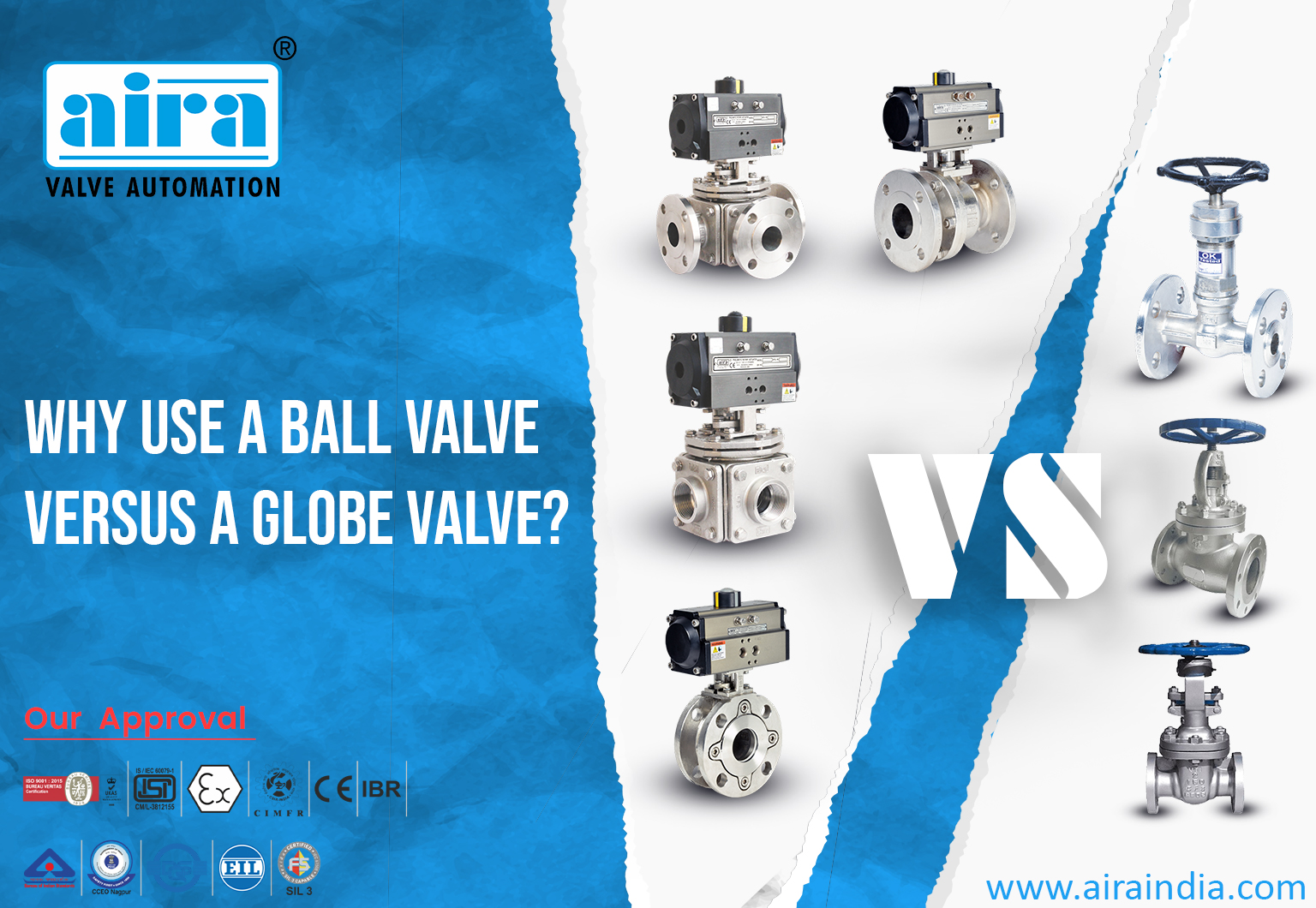
Ball valves and globe valves are both widely used shut-off valves in piping systems, but they work in fundamentally different ways — and that difference affects cost, space, flow control, and how well each one holds up over time. This guide breaks down exactly how they compare, so you can match the right valve to your application.
Ball Valve vs Globe Valve: Quick Comparison
| Feature | Ball Valve | Globe Valve |
|---|---|---|
| Operation | Quarter-turn (90°) | Multi-turn (360°+) |
| Throttling | Poor — full open/closed only | Excellent — designed for precise flow control |
| Pressure drop (fully open) | Low | High |
| Space required | Compact | Larger |
| Typical cost | Lower | Higher |
| Pressure rating | Generally higher | Generally lower |
| Durability | Longer service life, fewer wear points | More prone to wear at the seat |
| Leak tightness | Excellent, tight shutoff | More prone to leakage over time |
| Best suited for | Fast shutoff, isolation, high flow rate | Precise throttling, frequent flow adjustment |
How a Ball Valve Works
A ball valve is a quarter-turn valve — the handle only needs a 90° turn to move from fully open to fully closed. A ball with a bore through its center sits on the valve seat, connected to the stem and handle. When the bore is aligned with the pipe ports, fluid flows freely; when the handle turns 90°, the bore rotates perpendicular to the flow path and blocks it completely. O-ring stem seals prevent leakage around the moving parts. Learn more on our ball valves product page.
How a Globe Valve Works
A globe valve is a multi-turn valve — the handwheel must be turned more than 360° to fully open or close it. Its main components are the body, bonnet, handwheel, stem, and plug (disc). Turning the handwheel raises or lowers a threaded stem, which moves the plug relative to the valve seat. Raising the plug opens the flow path; the flow rate increases as the plug rises, peaking when it’s fully raised. Lowering the plug back onto the seat shuts off flow. Check our globe-type control valves for available configurations.
Flow Control Comparison
Globe valves have a clear advantage for throttling — regulating flow at partial openings — because the plug’s design allows fine, stable control across the full range of motion, which also helps reduce water hammer at higher linear flow rates. Ball valves are built for reliable full on/off operation; some multi-port and V-notch ball valve designs offer limited throttling capability, but standard ball valves are best used fully open or fully closed.
Pressure Loss Comparison
Ball valves have significantly lower pressure loss when fully open, because fluid passes straight through the bore in a single, unobstructed path. Globe valves force fluid to change direction multiple times as it moves through the body and around the plug, which creates meaningfully higher head loss even when fully open — a trade-off for the precise throttling control globe valves offer.
Design Types
Ball Valve Design Types
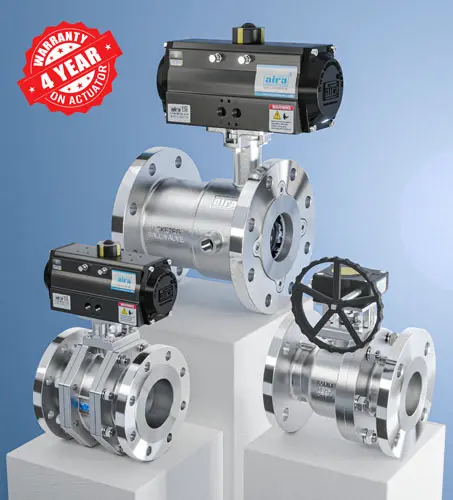
Ball valves are categorized by housing construction and port design. By housing, Aira manufactures 1-piece, 2-piece, and 3-piece ball valves. By port size, they’re available as full port, standard port, or reduced port. By port count, they come in two-way and multi-port (3-way, 4-way, 5-way) configurations.
Globe Valve Design Types
Globe valves are available in three basic body configurations: T- or Z-pattern, Y-pattern, and angle globe valves, each suited to different pressure drop and flow-path requirements. See our globe-type control valves range for details on each.
Applications
Globe valves are commonly specified where precise throttling is required — fuel oil systems, cooling water systems, and other processes needing fine flow adjustment. Ball valves are the standard choice for shut-off and isolation duty — plumbing systems, chemical storage, and natural gas distribution, where fast, reliable on/off operation matters more than flow modulation.
Similarities Between Ball and Globe Valves
Despite their different mechanisms, both valve types serve the same basic purpose: they’re shut-off valves used to start, stop, or manage the flow of liquids and gases through a pipeline, and both can be operated manually or automated with an actuator for remote and process control.
Ball Valve vs Globe Valve vs Gate Valve
A third valve type is worth a mention, since it’s commonly compared alongside these two: the gate valve. Like a globe valve, a gate valve is multi-turn, but instead of a plug seating against a fixed point, a gate lifts fully clear of the flow path — giving gate valves very low pressure loss when fully open, similar to ball valves, but without a quarter-turn’s speed of operation.
| Feature | Ball Valve | Globe Valve | Gate Valve |
|---|---|---|---|
| Operation | Quarter-turn | Multi-turn | Multi-turn |
| Best for | Fast on/off | Precise throttling | Full on/off, low resistance |
| Throttling | Poor | Excellent | Poor (can erode the gate) |
| Pressure loss (open) | Low | High | Low |
In short: choose a ball valve for fast, reliable isolation; a globe valve when you need to regulate flow precisely; and a gate valve when you need a low-resistance, full on/off valve and speed of operation isn’t critical. Explore Aira’s knife edge gate valves for slurry and solids-handling applications where gate valves are commonly specified.
How to Choose Between a Ball Valve and a Globe Valve
- Need fast, frequent on/off operation? A ball valve’s quarter-turn action and durability make it the better fit.
- Need to fine-tune or throttle flow? A globe valve’s design is purpose-built for this; a standard ball valve is not.
- Working with limited installation space? Ball valves are more compact for a given pipe size.
- Handling high system pressure? Ball valves generally offer higher pressure ratings.
- Budget-constrained project? Ball valves are typically less expensive due to their simpler construction.
- Minimizing long-term maintenance? Ball valves generally require less upkeep and have fewer wear-prone components than globe valves.
Aira Euro Automation manufactures ball valves, globe-type control valves, knife edge gate valves, butterfly valves, and plug valves for industrial process applications. Get a quote or explore our full product range.