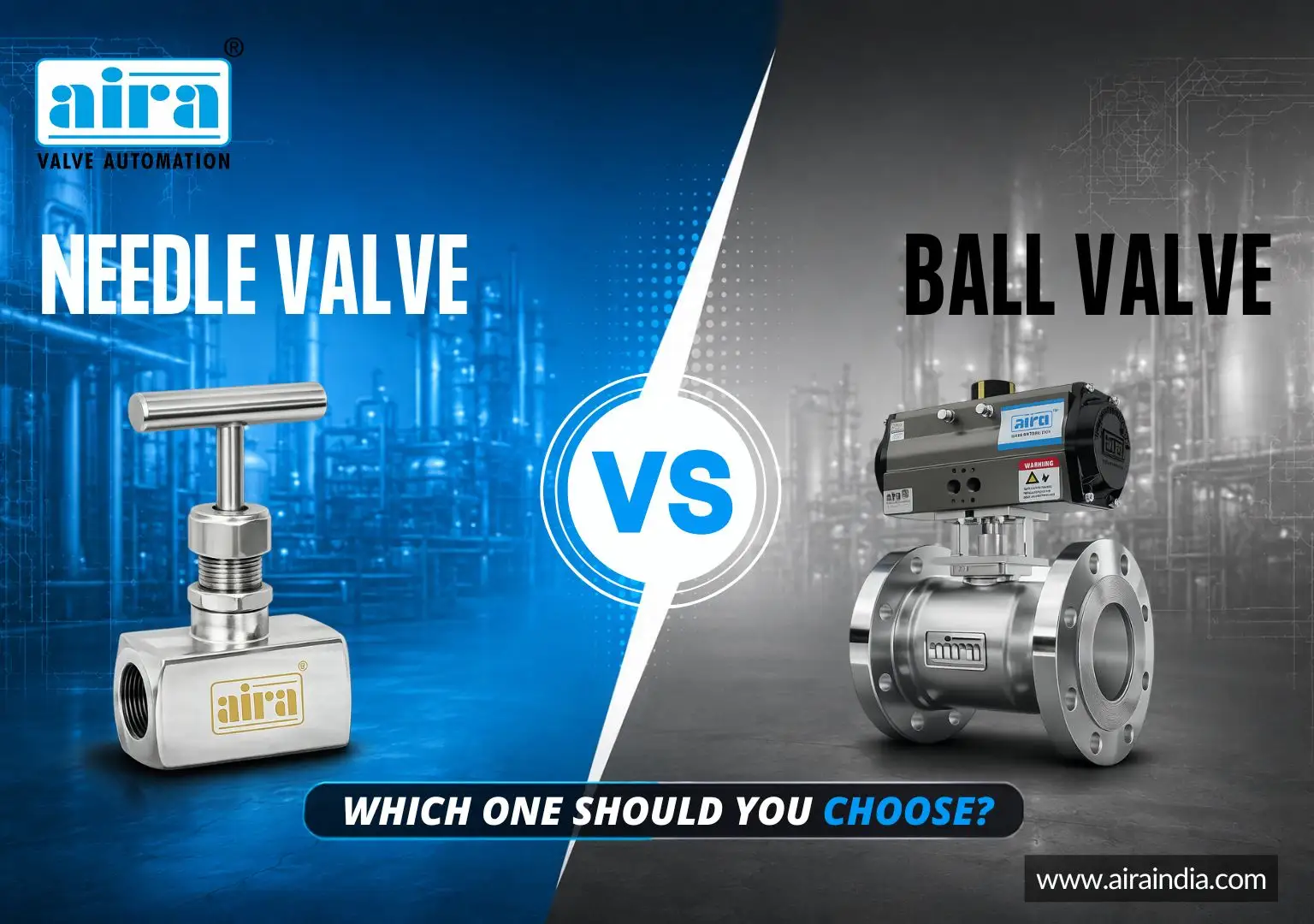
At first glance, a needle valve and a ball valve might seem to serve the same basic purpose: they both stop and start flow through a pipeline. But spend a few minutes looking at how they are built and where they are actually used, and the differences become very clear, very quickly.
Choosing between the two is not always a straightforward call. It depends on what your process actually demands: whether you need precise, fine-tuned flow control, or fast and reliable shut-off. Get this decision right, and you will have a valve that performs exactly as expected for years. Get it wrong, and you will be dealing with control problems, premature wear, or a valve that simply cannot do the job you need it to do.
This comparison breaks down the key differences between needle valves and ball valves not what they are, but how they perform against each other across the factors that actually matter when you are making a selection decision.
The Core Difference: Precision Control vs Fast Shut-Off
This is the fundamental distinction, and everything else flows from it.
A needle valve is built for precision. Its tapered needle-shaped plunger moves through a small seat to regulate flow with very fine accuracy. You can open it just a fraction and hold a consistent, low flow rate something that most other valve types simply cannot do reliably. This makes it the go-to choice in instrumentation, metering lines, gauge connections, and anywhere that precise flow control at low rates matters.
A ball valve, on the other hand, is built for speed and reliability. A quarter-turn of the handle moves the ball from fully closed to fully open. It is not designed to sit at 30% open and regulate flow; it is designed to either allow full flow or stop it completely. This makes it the right choice for isolation, shut-off, and on/off service across a huge range of pipe sizes and pressures.
Understanding this distinction immediately eliminates a lot of confusion. If you need to control how much it flows, think needle valve. If you need to control whether it flows, think ball valve.
Flow Control: Where Each Valve Performs Best
Needle Valve Fine Flow Regulation
The needle valve’s tapered plug creates a very small, variable flow path. As you turn the handwheel, the plug moves up or down through the seat, opening or closing the flow path in very small increments. This gives the operator or control system extremely fine control over flow rate — far more precise than any ball valve can achieve.
This precision is valuable in applications like instrument air supply lines, hydraulic circuit control, chemical dosing systems, and calibration equipment where even a small variation in flow rate affects the process outcome.
The trade-off is that needle valves are designed for relatively low flow rates. Their small orifice size means they are not suited for moving large volumes of fluid. They also have a higher pressure drop compared to a fully open ball valve of the same nominal pipe size.
Ball Valve Full Bore Flow with Minimal Restriction
A full-bore ball valve in the fully open position has virtually no restriction to flow; the bore of the ball matches the pipe bore, so fluid passes straight through with minimal pressure drop. This is one of the ball valve’s biggest advantages in main pipeline service, where flow capacity and low resistance matter.
However, modulating a ball valve by trying to use it at partial open positions to regulate flow is generally a poor idea. Ball valves are not designed for throttling service. Operating a standard ball valve at partial open creates turbulence, causes erosion of the ball and seat, and leads to premature failure. If you need to regulate flow with a ball valve, you need a specifically designed, characterized ball valve, which is a different product category altogether.
Pressure and Temperature Handling
Both valve types are available across a wide range of pressure and temperature ratings, so neither has a categorical advantage here. But there are practical differences in how each handles demanding conditions.
Needle valves are commonly used in high-pressure instrument and gauge connections, often up to 400 bar or more in specialized designs. Their small orifice and robust body construction make them well suited for high-pressure service at low flow rates. A needle valve in a pressure gauge isolation or hydraulic test connection is a typical example.
Ball valves cover an enormous pressure range in standard industrial service from low-pressure utilities up to high-pressure pipeline and process applications. Large bore ball valves in pipeline service are rated for pressures that would be impractical for a needle valve of equivalent bore size.
For temperature, both types are available in materials suitable for cryogenic service through to high-temperature steam applications, depending on body material, seat material, and packing selection. Neither type has a fundamental temperature limitation that the other does not share.
Speed of Operation and Automation
If your application requires a valve that can open or close quickly in a few seconds, a ball valve is the clear winner. A quarter-turn actuator, whether pneumatic or electric, can stroke a ball valve from fully closed to fully open in a second or two. This makes ball valves ideal for automated on/off control, emergency shutdown systems, and any application where fast response is needed.
Needle valves are multi-turn devices. Achieving a specific flow setting requires multiple turns of the handwheel, which takes time. They can be automated with motorized actuators for position control, but they are not suited for rapid open/close cycling. Their strength is in slow, deliberate, fine adjustments, which is exactly what instrumentation and flow-metering applications require. Pneumatic actuators are sometimes used on needle valves in process control applications, but the typical application for a pneumatic actuator is the ball or butterfly valve in fast on/off service.
Maintenance and Longevity
Needle Valve Maintenance
Needle valves have relatively simple internals: a threaded stem, a tapered needle, and a seat. The most common maintenance task is repacking the stem seal to address leakage past the stem. In corrosive or high-pressure service, the needle and seat can wear over time and may need lapping or replacement.
The key maintenance consideration for needle valves is to avoid forcing them closed under high differential pressure. The tapered needle can embed into the soft seat material if closed too hard, which damages both the needle tip and the seat. Closing with a firm but not excessive turn is the correct practice.
Ball Valve Maintenance
Ball valves in clean service are low-maintenance components. The PTFE or reinforced seats are designed to last for many years and many thousands of cycles without attention. The main maintenance activities are stem packing adjustment or replacement if external leakage develops, and seat replacement if internal leakage past the ball becomes unacceptable.
In dirty or abrasive service, the ball surface and seats wear faster. Selecting the right seat material and ball coating chrome-plated, electroless nickel, or hard-faced depending on the service significantly extends service life in demanding applications.
Side-by-Side Comparison
Here is a quick reference across the key selection factors:
Flow Control Precision
- Needle Valve: Excellent designed for fine flow regulation
- Ball Valve: Poorly designed for full open or full closed only
Flow Capacity
- Needle Valve: Low small orifice, higher pressure drop
- Ball Valve: High full-bore option with minimal restriction
Speed of Operation
- Needle Valve: Slow multi-turn handwheel
- Ball Valve: Fast quarter-turn, easy to automate
High Pressure Suitability
- Needle Valve: Excellent for small bore, high pressure instrumentation
- Ball Valve: Excellent across a wide range of bore sizes and pressures
Throttling / Modulating Service
- Needle Valve: Yes, purpose-designed for it
- Ball Valve: No, not suitable for standard ball valves
On/Off Isolation Service
- Needle Valve: Possible but not ideal; slow to operate
- Ball Valve: Yes, this is its primary purpose
Automation Compatibility
- Needle Valve: Limited multi-turn actuators required
- Ball Valve: Excellent; simple quarter-turn actuators
Maintenance Frequency
- Needle Valve: Moderate stem packing, needle and seat wear
- Ball Valve: Low in clean service; seat and packing checks
Typical Applications
- Needle Valve: Instrumentation, metering, gauge isolation, dosing
- Ball Valve: Pipeline isolation, process shut-off, automated on/off control
When to Choose a Needle Valve
Choose a needle valve when your application requires:
- Fine, precise control of flow rate at relatively low flow volumes
- Instrument connections, gauge isolation, or sample point isolation
- Chemical metering or dosing at controlled, repeatable rates
- Hydraulic or pneumatic circuit pressure adjustment
- Calibration equipment or test bench flow control
- High-pressure small bore connections where fine adjustment is needed
If precise flow regulation is what your process demands, the needle valve is the right tool. No other standard valve type gives you the same level of fine-tuned control in a compact, robust body.
When to Choose a Ball Valve
Choose a ball valve when your application requires:
- Reliable on/off isolation in main process lines
- Fast operation, manual or automated
- High flow capacity with minimal pressure drop
- Frequent cycling in automated systems
- Emergency shutdown or safety isolation duty
- General utility service water, air, steam, gas — at any scale
For anything where the valve needs to open quickly, close positively, and handle significant flow volumes, the ball valve is the better choice. It is one of the most versatile valve types in industrial service for exactly these reasons.
Can You Use Both in the Same System?
Absolutely, and in many process plants, you will find both needle valves and ball valves working together in the same system, each doing the job it is designed for.
A typical example: a ball valve provides main line isolation on a process pipeline, while a needle valve on a branch connection controls the flow to a pressure gauge or instrument transmitter. The ball valve handles the bulk flow isolation; the needle valve protects and controls the instrument connection.
In a chemical dosing system, you might use a ball valve for main supply isolation and a needle valve downstream to set the precise dosing rate to the process. Each valve is doing exactly what it is designed to do, and together they give you both flexibility and precision.
Working with a valve manufacturer in India who supplies both product types allows you to source these complementary components from a single supplier, simplifying procurement and ensuring consistent quality across your valve inventory.
Connect With Aira Euro for Needle Valves and Ball Valves
Aira Euro supplies a comprehensive range of needle valves and ball valves for industrial applications across India. Whether you are specifying valves for a new project or looking to replace existing components with correctly matched alternatives, Aira’s team can help you make the right selection for your specific process conditions.
As a trusted valve manufacturer in India, Aira Euro offers genuine application engineering support, not just product supply. Contact Aira Euro today at www.airaindia.com/contact to discuss your valve requirements and get the right solution for your application.
Conclusion
Needle valves and ball valves are both excellent products, but they are designed for fundamentally different jobs. A needle valve provides precise flow control in low-volume, high-accuracy applications. A ball valve gives you fast, reliable on/off isolation across a wide range of pipe sizes and flow conditions.
The right choice comes down to what your process actually needs. If the answer is fine flow regulation, choose a needle valve. If the answer is reliable shut-off and high flow capacity, choose a ball valve. And if your system needs both, which is common, use both, each in the role it is built for.
Partnering with an experienced valve manufacturer in India, such as Aira Euro, ensures you have access to both product ranges and the technical guidance to specify each correctly for your application.
Frequently Asked Questions
What is the main difference between a needle valve and a ball valve?
The main difference is their intended function. A needle valve is designed for precise, fine flow regulation, allowing accurate control of fluid flow. A ball valve is designed for fast and reliable on/off isolation, enabling or stopping flow with a simple quarter-turn operation. Choosing the correct valve for its intended application ensures reliable performance and longer service life.
Can a ball valve be used for flow control instead of a needle valve?
Standard ball valves are not recommended for continuous throttling or flow control. Operating a ball valve in a partially open position creates turbulence, accelerates wear on the ball and seats, and can lead to premature failure. For precise flow regulation, a needle valve or a purpose-built control valve is the better choice.
Which valve is better for high-pressure applications?
Both needle valves and ball valves are available for high-pressure service, but they serve different purposes. Needle valves are commonly used for instrument lines, pressure gauges, and precise flow metering at high pressures. Ball valves are preferred for high-pressure pipeline isolation where quick shut-off and full-flow capability are required.
Which is easier to automate, a needle valve or a ball valve?
Ball valves are much easier to automate because they require only a quarter-turn movement, making them ideal for pneumatic and electric actuators. Needle valves require multi-turn actuators, which are generally slower and more complex. For automated on/off applications, ball valves are the preferred choice.
How do I know which valve to specify for my application?
Start by identifying the required function. If your application requires precise flow regulation, choose a needle valve. If you need reliable on/off isolation or full-flow operation, select a ball valve. Also consider operating pressure, temperature, media type, flow rate, and automation requirements. Consulting an experienced valve manufacturer can help ensure the correct valve selection for your process.