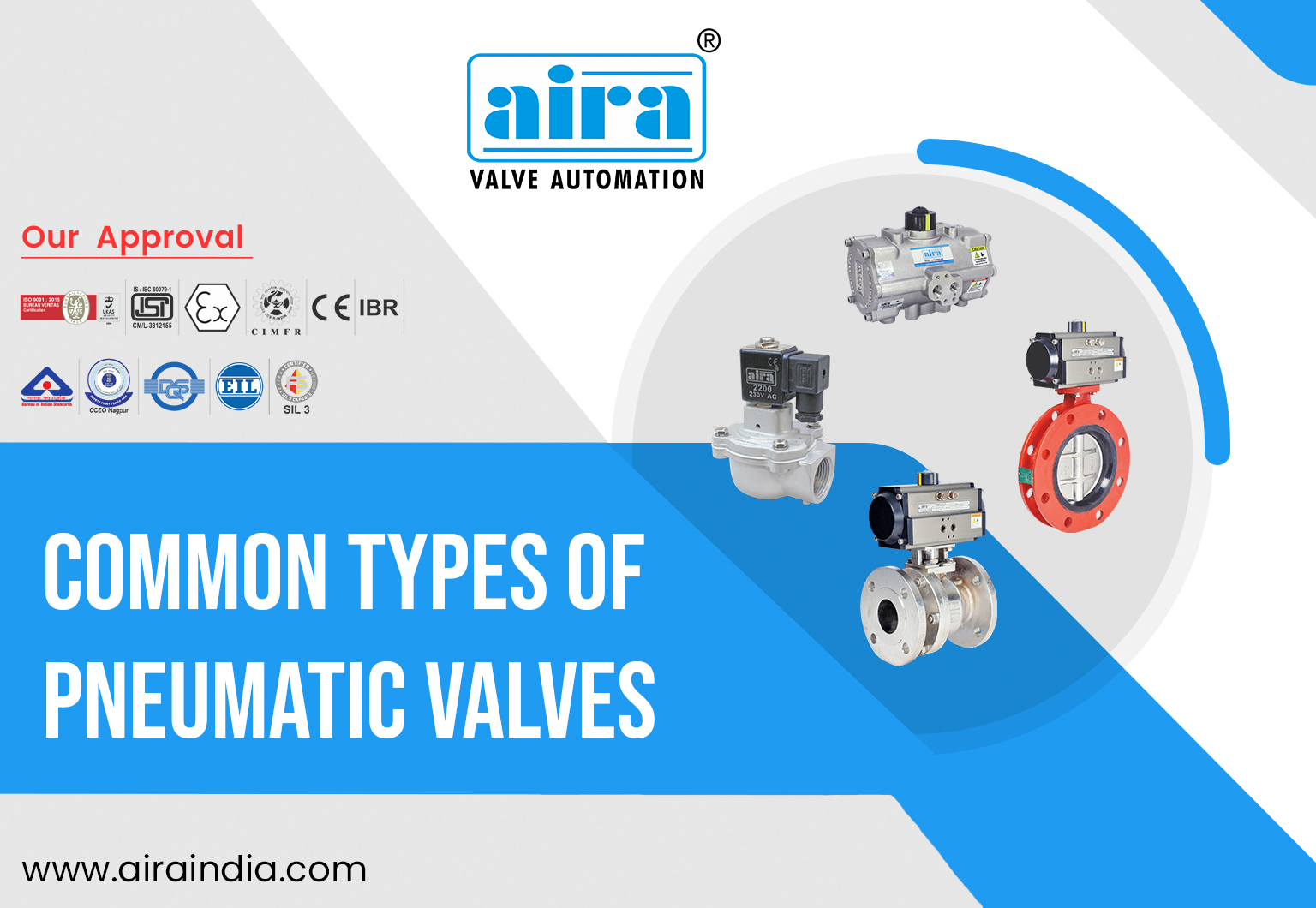
A pneumatic valve controls the flow, direction, or pressure of compressed air within a pneumatic system. In industrial applications, most pneumatic valves are actuator-operated — meaning compressed air drives a piston or diaphragm that opens or closes the valve, rather than a person turning a handwheel. This makes them faster to operate, easier to automate, and simpler to integrate into remote or hazardous environments than manually operated valves.
Pneumatic valves are classified in a few different ways: by their design (ball, butterfly, control, plug, and so on), by their actuation method (single-acting or double-acting), and by their function within the system (on-off isolation, flow regulation, backflow prevention, or pressure relief). This guide covers each of these, along with the working principle behind pneumatic actuation and the key advantages of using pneumatic valves over other control methods.
What Is a Pneumatic Valve?
A pneumatic valve is a valve operated by compressed air rather than by hand, electricity, or hydraulic fluid. Air pressure acts on an actuator — typically a piston or diaphragm — connected to the valve’s closure element (a ball, disc, or plug, depending on the valve type). Applying air pressure moves the actuator, which opens or closes the valve. Removing that pressure lets a spring — or an opposing air signal — return the valve to its original position.
The pneumatic valve is capable of switching on and off a single flow route as well as exact proportional pressure and flow control.
Most pneumatic valves include a control function, which may be described as the valve’s operation in any process or quality control. A control function requires control energy, which is defined by the manner of actuation (manual, mechanical, hydraulic, or pneumatic).
Aira Euro Automation is India’s top valve manufacturer. We are well-known for offering the best quality pneumatic valves in the industrial market. Our premium Pneumatic Ball Valves, Pneumatic Butterfly Valves, Pneumatic Control Valves, and Solenoid Valves are the leading choices in the industrial market.
How Pneumatic Valves Work
Pneumatic control valves use actuators and positioners controlled by a controller to lower pressure safely. Controllers can detect pressure changes and alter the air supply signal sent to the pneumatic positioner. A pneumatic positioner would pump air into the diaphragm, allowing a valve to be opened. Springs are used as an opposing force, causing the valve to close when air pressure applied to the diaphragm is lost or reduced. Many industries rely on pneumatic control valves.
How Pneumatic Valves Are Classified
Pneumatic valves are commonly grouped in a few ways:
By design — ball, butterfly, diaphragm/globe control, plug, knife-edge gate, non-return, and pressure relief valves, each suited to different flow and pressure conditions.
>By actuation — single-acting (spring-return) or double-acting (air-driven in both directions).
>By function — on-off isolation valves, throttling/control valves, check (non-return) valves, and pressure-relief valves.
You may also come across pneumatic valves classified by port and position count (for example, 3/2-way or 5/2-way valves) — this numbering describes pilot/directional valves used in pneumatic control circuits, separate from the actuator-operated process valves covered in detail below.
At Aira Euro Automation, we produce a comprehensive range of Pneumatic Valves — including ball, butterfly, control, plug, knife-edge gate, non-return, and solenoid valves — to meet the needs and support the expansion of your business and industry.
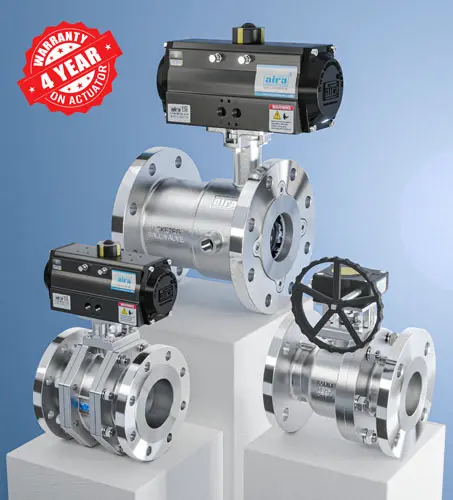
Pneumatic Ball Valve
Aira offers a wide range of Pneumatic Ball Valves, which control the flow if liquid or gas through a rotating ball with a bore. Pneumatic Actuators convert compressed air energy into mechanical motion, controlling the rotating ball. These valves consist of two main components: the pneumatic actuator and ball valve, which are typically mounted together by API 6D & ISO 17292 for ANSI Class ratings 150 to 600, with Nominal Size available from “½ to 12” inches.
Pneumatic actuators can be single or double-acting, with single-acting actuators using compressed air to rotate the ball and a spring to move it back to its normal position, and double-acting actuators Using pressurized air, move the ball in any direction.
“Air-actuated ball valves are a reliable solution and often have a lower investment cost for larger valves than electric ones.”
There are various housings and sizes of pneumatic ball valves, making it easy to find the right one for your application. Air-operated ball valves are commonly used to remotely control fluid flow, such as water pipes or air hoses.
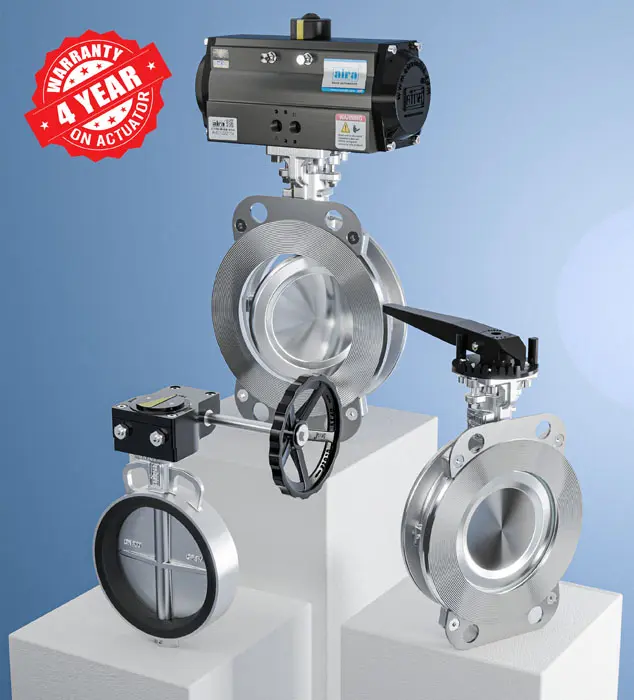
Pneumatic Butterfly Valve
These valves come with either a lug or a wafer connection design. Depending on the actuator type (single or double-acting), the actuator will open and close the butterfly valve with compressed air. The butterfly valve contains a disk that revolves with the actuator to open and close it.
The butterfly valve design provides excellent sealing qualities, longevity, and dependability for your application. Pneumatic actuators are a dependable option that is frequently utilized to operate bigger valves than electric actuators at a cheaper initial cost. Pneumatically controlled butterfly valves come in a variety of housings, seals, and sizes, making it easy to pick the correct one for your application.
Pneumatic Control Valve:
Aira Euro Automation’s Pneumatic Control Valves use a diaphragm or globe-style actuator to precisely regulate flow rather than simply switching it on or off. A positioner meters compressed air to the diaphragm, pushing it against a spring. This lets the valve throttle open by a proportional amount instead of simply opening or closing fully. This makes control valves the right choice wherever a process needs fine-tuned flow or pressure regulation — not just isolation.
Aira manufactures both 2-way and 3-way diaphragm control valves, along with globe-type and Y-type control valves, to suit different piping configurations and flow-control needs across process industries.
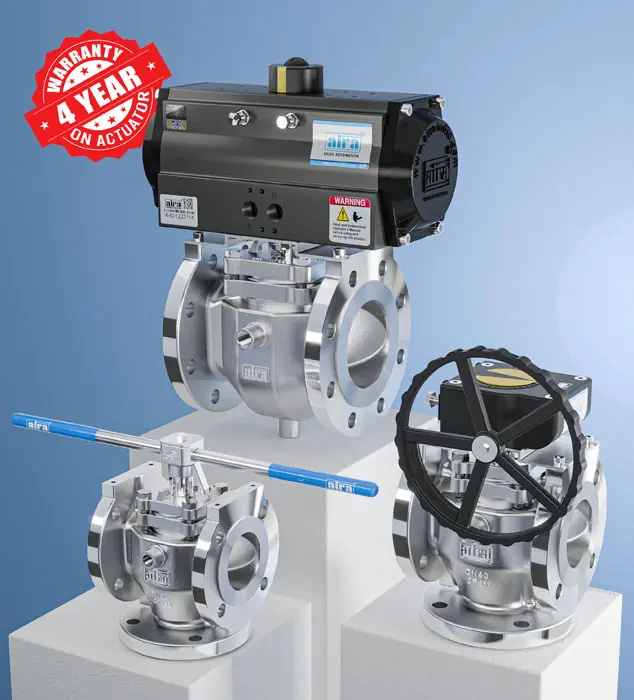
Pneumatic Plug Valve
A Pneumatic Plug Valve uses a tapered or cylindrical plug with a bored passage that rotates, similar in principle to a ball valve, to open or close the flow path. Aira’s pneumatic plug valves use the same single-acting or double-acting principles described above. Engineers commonly choose them for viscous fluids, slurries, or applications that need a straight-through flow path with minimal pressure drop.
Pneumatic Knife-Edge Gate Valve
Pneumatic Knife-Edge Gate Valves use a sharpened gate that slides across the flow path, making them well suited to handling slurries, powders, and fibrous or viscous media that would clog a standard ball or butterfly valve. Aira offers these in both uni-directional and bi-directional configurations. Pneumatic actuation lets them run remotely or automatically, even in demanding process environments.
Pneumatic Non-Return (Check) Valve
A Pneumatic Non-Return Valve allows flow in one direction only, closing automatically to prevent backflow when flow reverses or stops. Pneumatic actuation lets Aira’s non-return valves integrate into automated systems, so backflow prevention works in coordination with the rest of the pneumatic circuit instead of relying on passive check-valve action alone.
Pneumatic Solenoid Valves:
A solenoid valve is a pneumatic valve that operates using pneumatic force. When air pressure is applied to the solenoid coil, a magnetic field is formed, causing a ferrous metal rod to move. This is the fundamental mechanism that opens the valve, and it acts either directly or indirectly on air.
Normally open (N/O), the valve remains open when the solenoid is not charged. The valve is normally closed (N/C) when the solenoid is not charged. Solenoid valves eliminate the need for human or pneumatic control of a pneumatic circuit, requiring just an electrical input (and air pressure for piloted valves) to function, making them simple to configure and install in a broad range of applications.
Advantages of Pneumatic Valves
Pneumatic Systems are designed to transmit and control energy using compressed air. Pneumatic systems are found in manufacturing lines, tran doors, and mechanical clamps. Many industrial companies would only be able to function with the specialized use of pneumatic control systems. Pneumatics is often the driving force behind automated machines. Among the advantages of using these devices are:
Compressed air systems never run out of air because an infinite amount of air in our atmosphere can be used to provide compressed air. Compressed air is easily delivered through pipes and is not restricted by distance. When compressed air is released back into the atmosphere, it does not require recycling or processing. The instruments are long-lasting and dependable. When compared to other electromotive elements, these machine’s components, such as pneumatic valves, are not easily damaged.
Pneumatic systems are typically believed to be safer than electrometer systems. This is because pneumatic systems do not emit sparks or explosions, implying that they may be used in flammable situations.
Unlike electromotive components, pneumatic systems do not overheat or burn when overloaded.
Key Components of a Pneumatic Valve
Every pneumatic valve, regardless of design, shares a few core components:
- Valve body — houses the flow path and closure element (ball, disc, plug, or gate).
- Actuator — the pneumatic piston or diaphragm that converts compressed air into mechanical motion.
- Spring (single-acting valves only) — returns the valve to its default position once air pressure drops.
- Positioner — meters the air signal to the actuator for precise, proportional control (mainly on control valves).
- Ports and seals — manage air supply/exhaust and prevent leakage at the valve seat.
Understanding these components makes it easier to specify the right valve for a given application, and to diagnose issues when a valve isn’t actuating as expected.
Conclusion
Pneumatic valves are essential components across countless industrial applications, offering precise control over airflow and pressure. From ball and butterfly valves to control, plug, knife-edge gate, and non-return valves, each type serves a specific role in keeping pneumatic systems running efficiently and reliably.
Understanding the working principle and application of each valve type makes it easier to choose the right one for your system, leading to better performance, easier maintenance, and fewer unplanned failures. As automation demands grow, pneumatic valves continue to offer a reliable, cost-effective way to control industrial processes.
Trust Aira Euro Automation — India’s leading valve manufacturer in Ahmedabad, offering a complete range of pneumatic ball, butterfly, control, plug, knife-edge gate, non-return, and solenoid valves for industrial applications.