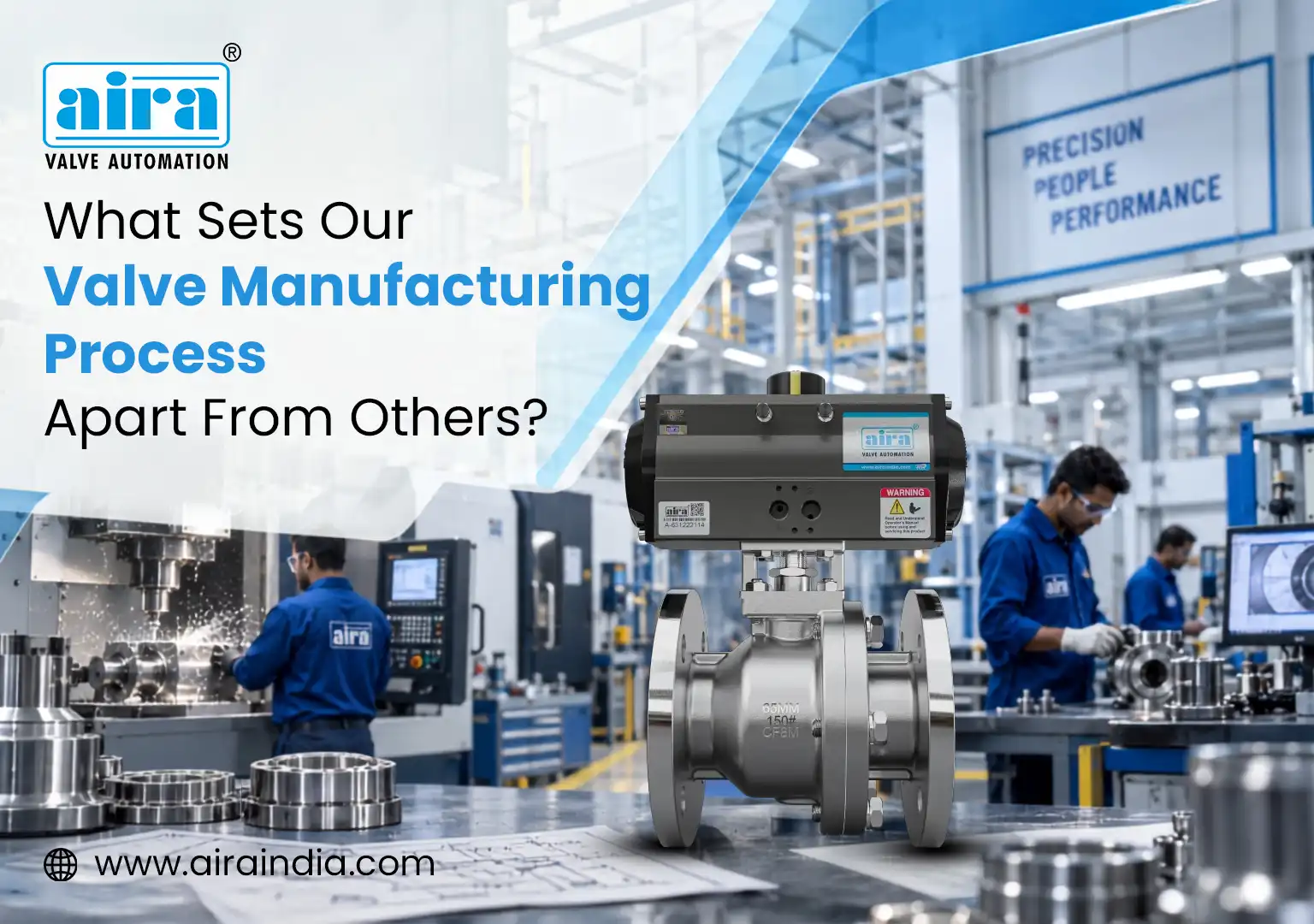
Walk into most valve companies in India and you’ll find a warehouse, not a factory. Components arrive from a dozen different job-work vendors, get assembled, tested, boxed, and shipped out under a brand label. It works — until something goes wrong with a casting, and nobody in the supply chain can tell you exactly where the problem originated.
That’s not how Aira Euro Automation operates, and it’s the single biggest reason engineers researching why to choose an industrial valve manufacturer keep landing on us instead of a trading company with a nice catalogue.
Quick answer: Aira’s manufacturing process is built on reverse integration — we own our investment casting foundry, in-house R&D, design engineering, machining, and testing, so every valve is controlled end-to-end under one roof instead of being assembled from third-party job-work components.
Here’s exactly what that looks like on the shop floor.
Reverse Integration: Manufacturing, Not Assembly
“Reverse integration” sounds like a corporate buzzword until you understand what it actually replaces. In a typical outsourced model, a valve company buys raw castings from an unrelated foundry, has them machined by another vendor, sources rubber seats and seals from a third supplier, and assembles the final product in-house — with quality checks happening only at the final inspection stage, long after the raw material decisions were already made by someone else.
Aira flips that model. Our process covers:
- Investment casting — valve bodies, discs, and trims are cast in our own foundry, where we control alloy composition, pour temperature, and mould precision from the first step.
- Rubber and elastomer manufacturing — seats, seals, and diaphragms are produced in-house rather than sourced from unverified third-party suppliers.
- Precision machining — CNC-machined to tight tolerances, keeping every batch dimensionally consistent.
- Assembly and finishing — trained technicians assemble each valve to documented specifications, not guesswork.
- In-process and final testing — hydrostatic, pneumatic, and seat leakage testing before anything leaves the facility.
When one team owns every one of these stages, there’s no finger-pointing between vendors when a defect surfaces — and far fewer defects to begin with, because quality is built in at the casting stage, not inspected for at the end.
Our Own Investment Casting Foundry: The Real Differentiator
If there’s one facility that explains Aira’s consistency, it’s our dedicated investment casting foundry. Investment casting (also called lost-wax casting) produces components with tighter dimensional accuracy and a smoother surface finish than sand casting — critical for valve bodies that need to seal reliably under pressure for years.
Owning this foundry means:
- Material traceability. Every batch of raw material can be traced back to its source and certified accordingly — essential for Oil & Gas and Pharma clients who require Material Test Certificates (MTCs).
- Faster turnaround on custom orders. We’re not waiting in a queue behind another foundry’s other clients.
- Tighter tolerance control. Fewer rejected castings, fewer rework cycles, and a more consistent final product.
- Cost stability. No middleman casting vendor adding margin on top of raw material costs, which keeps our pricing competitive even on large bulk orders.
This single piece of infrastructure is a major reason our certification portfolio — including ISO 9001:2015, CE, ATEX, and SIL-3 — actually means something in practice, rather than being a certificate that sits disconnected from the shop floor.
R&D and Design Engineering: Solving Problems, Not Just Filling Orders
A catalogue can only take a customer so far. Real industrial applications rarely fit a standard product sheet perfectly — unusual pressure ratings, corrosive media, tight installation envelopes, or non-standard flange patterns are the norm, not the exception.
That’s where our R&D division and design division come in. Our engineers work directly with customer teams to:
- Review process conditions (pressure, temperature, media, flow rate) before recommending a valve type
- Engineer custom trims, seat materials, and end connections for non-standard applications
- Validate designs through internal testing before committing to production
- Continuously refine existing product lines based on field performance data from repeat customers
This is a meaningfully different relationship than buying off a price list. It’s closer to working with an engineering partner who happens to also manufacture the final product.
Quality Policy and Testing: Verification at Every Stage
Manufacturing capability means little without a disciplined quality policy and testing regime to back it up. At Aira, testing isn’t a final gate before shipping — it’s built into multiple checkpoints across the process:
- Incoming material inspection — raw materials are verified against specification before entering production
- In-process dimensional checks — machined components are checked against drawings at multiple stages, not just at final assembly
- Hydrostatic and pneumatic pressure testing — every valve is pressure-tested to confirm body integrity and seat tightness
- Third-party witnessed testing — available on request for projects requiring independent verification (common in Oil & Gas EPC contracts)
This layered approach is also why our certifications hold up under real project audits: ISO 45001:2018 for occupational safety, ISO 14001:2015 for environmental management, and application-specific approvals like WRAS for potable water and ATEX for explosive atmospheres aren’t decorative — they’re backed by documented, repeatable processes.
Scalable Production Capacity for Every Order Size
A manufacturing process is only as good as its ability to actually deliver at scale. Our production capacity is built to serve two very different customer needs simultaneously:
- Large bulk orders for EPC contractors and OEMs who need hundreds of units on a fixed project timeline
- Small-batch, highly customized runs for plant engineers replacing a single obsolete valve with very specific specifications
With our factory footprint expanding to over 80,000 sq. mtr over the coming years, this dual capability is only growing — meaning shorter lead times regardless of order size.
Complete Product Range, One Consistent Process
Because our manufacturing process — casting, machining, testing — applies uniformly across our entire catalogue, customers get the same quality discipline whether they’re ordering:
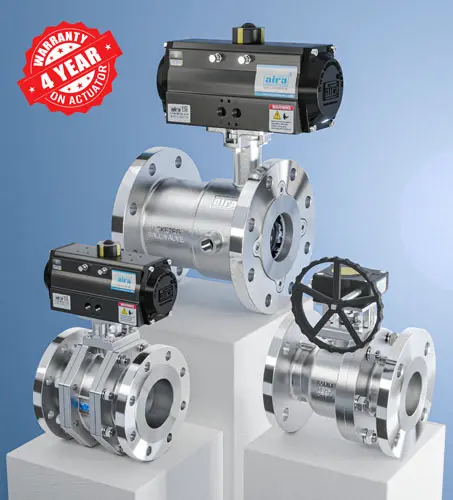
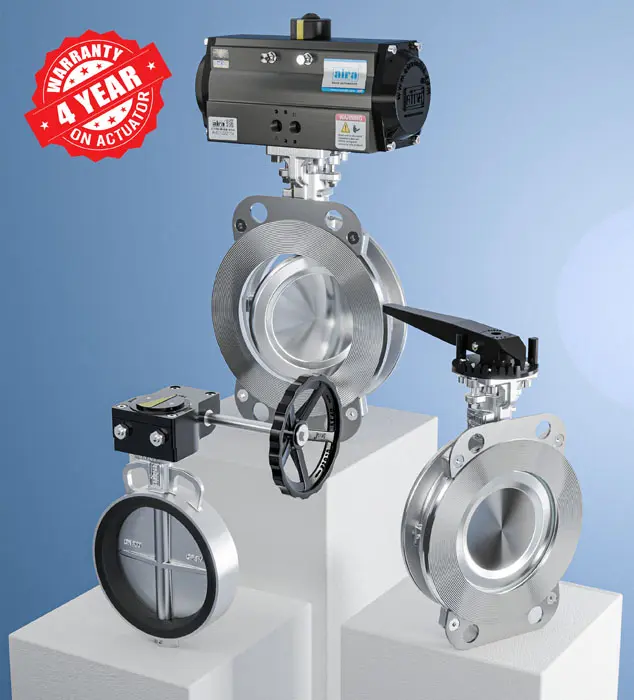
- Ball valves and butterfly valves for general isolation duty
- Control valves and solenoid valves for automated process lines
- Pneumatic actuators and accessories like positioners and limit switch boxes to complete automation packages
- Pharmaceutical valves for hygienic, sanitary process requirements
- Lined valves and knife edge gate valves for corrosive or slurry-handling applications
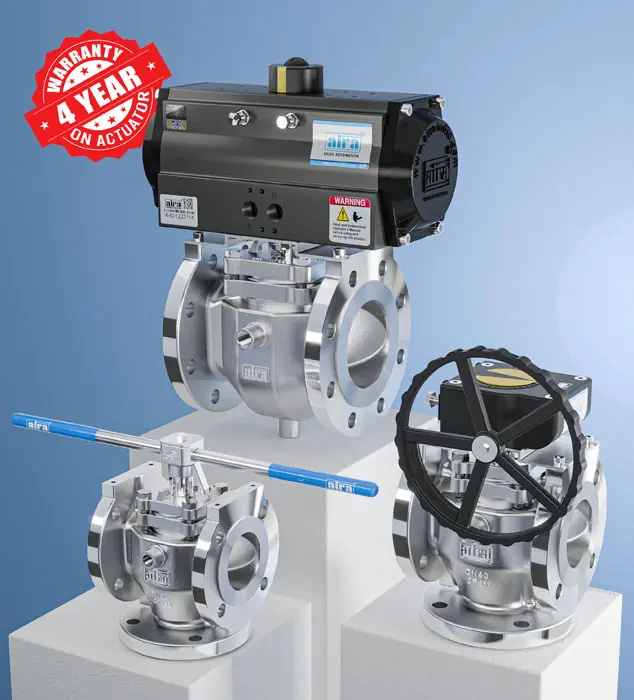
- Plug valves and PRV safety valves for critical shutoff and pressure relief duty
That consistency — not marketing language, but a genuinely uniform manufacturing standard — is what customers across Oil & Gas, Pharma, Power, and Water Treatment are really buying when they choose Aira.
Experience the Difference of a True Manufacturer
A reliable valve doesn’t start at final inspection — it starts at the casting stage, months earlier, with decisions about material, tolerance, and process discipline. That’s the advantage Aira Euro Automation brings to every project, whether it’s a single replacement valve or a full plant automation package.
Get a Quote from Aira Euro Automation
Frequently Asked Questions
What is reverse integration in valve manufacturing?
Reverse integration means a manufacturer controls a large part of the production chain in-house, from raw material casting and component manufacturing to final valve assembly and testing. This approach can provide greater control over quality, material traceability, production consistency, and delivery timelines compared with extensive third-party outsourcing.
Why does owning a casting foundry matter for valve quality?
Owning or directly controlling a casting foundry allows a valve manufacturer to maintain closer control over material specifications, casting quality, dimensional accuracy, traceability, and production timelines. It can also help reduce inconsistencies that may occur when critical cast components are sourced from unrelated third-party foundries.
How does Aira test valves before shipping?
Aira carries out incoming material inspection, in-process dimensional checks, and hydrostatic or pneumatic pressure testing as part of its valve quality process. Third-party witnessed testing can also be arranged when required by the customer or project specification.
Can Aira manufacture custom valve designs?
Yes. Aira’s in-house R&D and design capabilities support the development of customized valve configurations based on specific process requirements. Customization may include trims, seat materials, pressure ratings, materials, and other valve configurations depending on the application.
What certifications validate Aira’s manufacturing process?
Aira holds certifications and approvals including ISO 9001:2015, ISO 14001:2015, ISO 45001:2018, CE, ATEX, SIL-3, IBR, ISI, and WRAS. The applicable certification depends on the product, application, and required compliance standard.