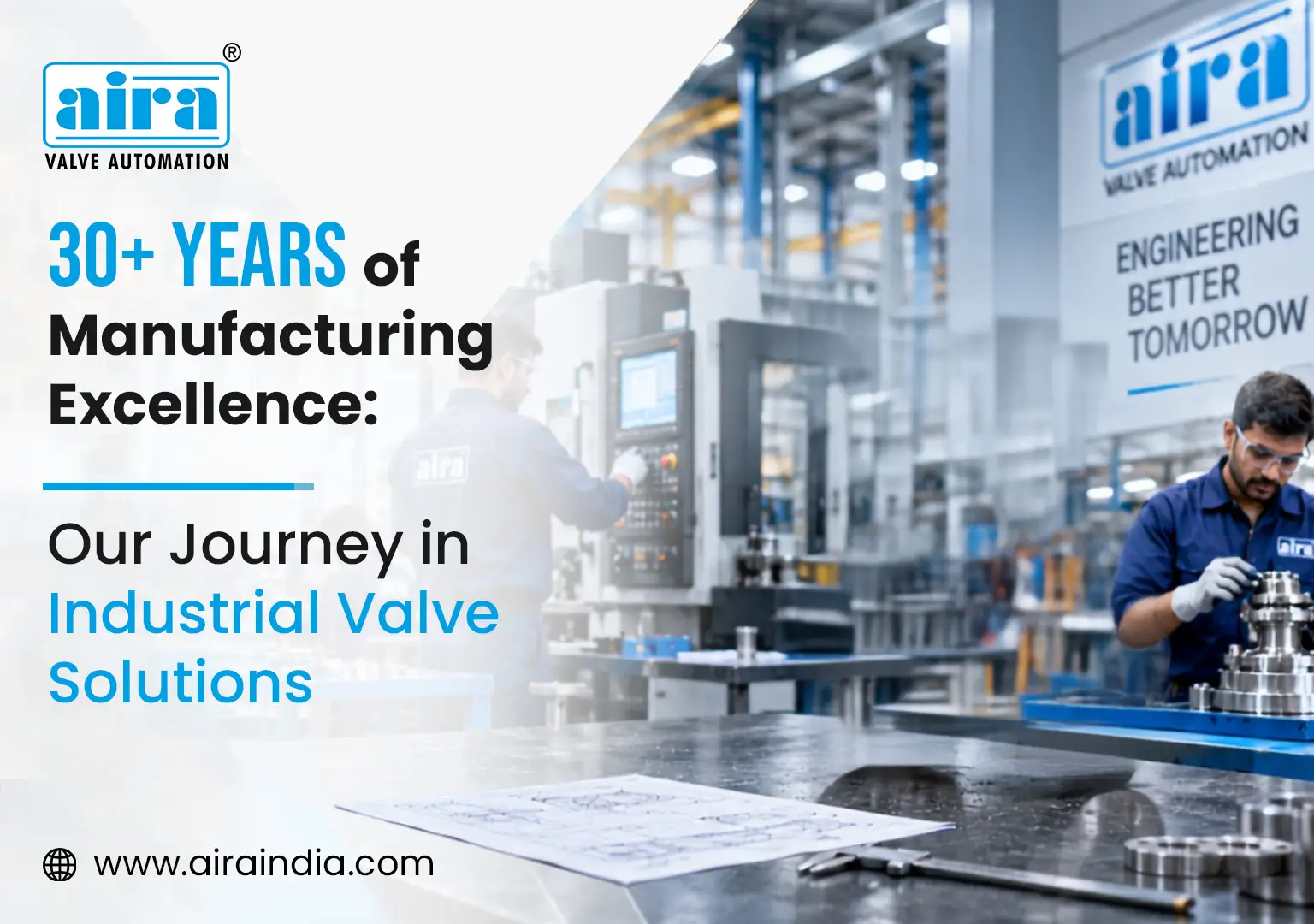
Most industrial valve companies in India started the same way Aira Euro Automation did — small, under-resourced, and competing against established importers who assumed no domestic manufacturer could match international quality. Three decades later, the story looks very different: a reverse-integrated manufacturing facility, a certification portfolio that clears international EPC audits, and a product range trusted across Oil & Gas, Pharma, Power, and Water Treatment, both in India and abroad.
This is the story of how that happened — and why it still shapes how we manufacture every valve today.
Quick answer: Aira Euro Automation is a 30-year-old, “Make in India” industrial valve and pneumatic actuator manufacturer based in Ahmedabad, Gujarat, that grew from a small manufacturing operation into a reverse-integrated facility with its own investment casting foundry, ISO/CE/ATEX/SIL-3/WRAS certifications, and a product range serving Oil & Gas, Pharmaceutical, Power, and Water Treatment industries worldwide.
The Starting Point: A Conviction, Not Just a Business Plan
Aira Euro Automation wasn’t built around a gap in the market discovered by a market research report. It was built around a straightforward conviction: India could manufacture industrial valves to international quality standards, without customers needing to default to imported products out of habit.
In the early years, that conviction was tested constantly. Trust in domestic manufacturing had to be earned project by project, valve by valve, at a time when “imported” was often treated as a shorthand for “reliable” and “Indian-made” carried an unfair presumption of compromise. Competing on that uneven playing field meant one thing above all: the product itself had to remove any doubt.
Building the Foundation: Infrastructure Before Scale
Rather than chasing volume early, the focus in Aira’s formative years went into infrastructure that most competitors were skipping — particularly the decision to build an in-house investment casting foundry instead of relying on third-party job-work casting, the way most valve traders and smaller manufacturers still do today.
This early decision is the single thread connecting Aira’s history to its present-day operations. It’s the same reverse-integrated approach — owning casting, machining, R&D, design, and testing under one roof — that we still rely on today, covered in detail in what sets our manufacturing process apart. Building that foundation first, before chasing rapid growth, meant that when growth did come, the quality and consistency to support it was already in place.
Earning Certifications the Hard Way: Process First, Paperwork Second
A recurring pattern across Aira’s 30-year history is that certifications followed real process improvements, not the other way around. ISO 9001 certification meant formalizing documentation and quality control systems that were already operationally sound. CE marking meant meeting European Pressure Equipment Directive requirements that pushed design and testing standards higher across the board. ATEX and SIL-3 certification meant engineering products specifically for hazardous-area and safety-critical applications, opening doors into Oil & Gas projects that previously required imported components by default.
Each certification represented a genuine capability upgrade, not just a marketing credential — which is precisely why our current certification portfolio holds up under real project audits today, three decades later.
Growing Into New Industries: From General Industrial to Specialized Applications
As manufacturing capability matured, so did the range of industries Aira could credibly serve. What began with general industrial and process valve applications expanded deliberately into sectors with much higher technical and regulatory demands:
- Oil & Gas and Petrochemicals, requiring ATEX and SIL-3 rated products for hazardous-area and safety-critical duty
- Pharmaceuticals, requiring hygienic, drainable valve designs and full material traceability for GMP compliance
- Water & Wastewater Treatment, requiring WRAS-approved products safe for potable water contact
- Power Generation, requiring IBR compliance for boiler-connected steam systems
Each of these sectors, detailed further in our industry-specific valve solutions guide, represented both a technical challenge and a trust-building exercise — proving, project after project, that domestically manufactured valves could meet the same standards as established international brands.
Scaling Without Losing the Manufacturing Discipline That Built the Company
The temptation for any growing manufacturer is to scale faster than infrastructure and quality systems can support — chasing volume at the expense of the consistency that built customer trust in the first place. Aira’s growth has deliberately avoided that trap.
Today, that shows up in tangible ways:
- Expanding production capacity — our factory footprint is growing to over 80,000 sq. mtr over the coming years, scaling capacity without compromising the reverse-integrated model that controls quality at every stage.
- Continued investment in R&D and design engineering — rather than freezing product development once a catalogue is established, our teams continue refining designs based on real field performance data from customers across industries.
- Export growth alongside domestic growth — with CE, ATEX, and WRAS certifications in place, Aira products now move into international projects, not just the domestic Indian market.
What 30 Years Actually Buys a Customer Today
For a customer evaluating vendors today, three decades of operating history isn’t nostalgia — it’s a practical risk-reduction signal. It means:
- Spare parts availability for older installations, because the manufacturer that built your valve is still operating and still manufacturing compatible components.
- Institutional engineering knowledge built across thousands of applications, not a single product cycle.
- Financial and operational stability, reducing the risk of a supplier disappearing mid-project or mid-warranty period.
- A track record that’s independently verifiable — through certifications, through existing installations, and through repeat customers who’ve already tested the relationship across multiple orders.
The Journey Continues
Thirty years in, Aira Euro Automation’s founding conviction hasn’t changed: that Indian manufacturing, done properly, can meet and exceed international standards, without customers needing to compromise on quality, compliance, or reliability. What has changed is the evidence behind that conviction — an in-house foundry, a full international certification portfolio, a product range engineered for the toughest industrial applications, and a growing global customer base that keeps coming back.
Partner With a Manufacturer That’s Built to Last
Thirty years of manufacturing discipline, reverse-integrated production, and a certification portfolio built for the world’s toughest industries — that’s the foundation Aira Euro Automation brings to every project, and it’s why our customers keep coming back for the next one.
Get a Quote from Aira Euro Automation | Call us: +91 90994 77256 | Email us: mkt@airaindia.com
Frequently Asked Questions
How long has Aira Euro Automation been manufacturing industrial valves?
Aira Euro Automation has over 30 years of experience manufacturing industrial valves and pneumatic actuators, based in Ahmedabad, Gujarat, India.
What was Aira’s key early decision that shaped the company’s growth?
Building an in-house investment casting foundry early on, enabling reverse-integrated manufacturing rather than relying on third-party job-work casting, which most competitors still depend on.
Does Aira Euro Automation export valves internationally?
Yes, with CE, ATEX, and WRAS certifications in place, Aira products are exported and used in international projects beyond the Indian domestic market.
How has Aira’s product range evolved over the years?
It expanded from general industrial and process valves into specialized applications for Oil & Gas, Pharmaceuticals, Water Treatment, and Power Generation, each requiring sector-specific certifications and design capabilities.
Why does a manufacturer’s operating history matter when choosing a valve supplier?
Longevity signals spare parts availability, financial stability, and accumulated engineering knowledge — all of which reduce risk for long-term industrial installations.