When automating industrial valves, the two most common choices are air operated valves (pneumatic) and electric actuated valves (motorized). Both serve the same basic purpose — opening and closing a valve automatically — but they differ significantly in how they work, where they perform best, and what they cost.
This guide by Aira Euro, one of India’s leading valve and actuator manufacturers, breaks down the key differences so you can make the right choice for your application.
What is an Air Operated Valve?
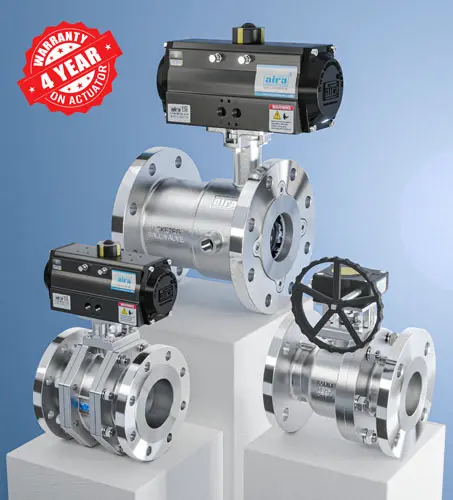
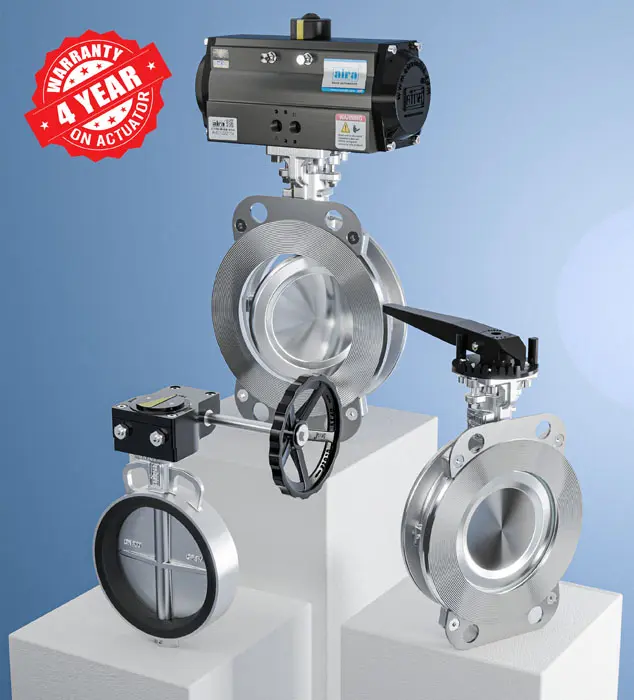
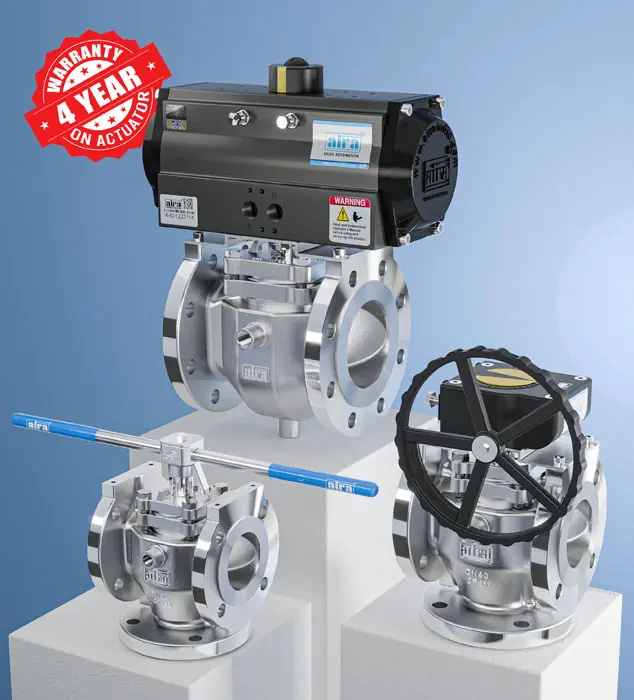
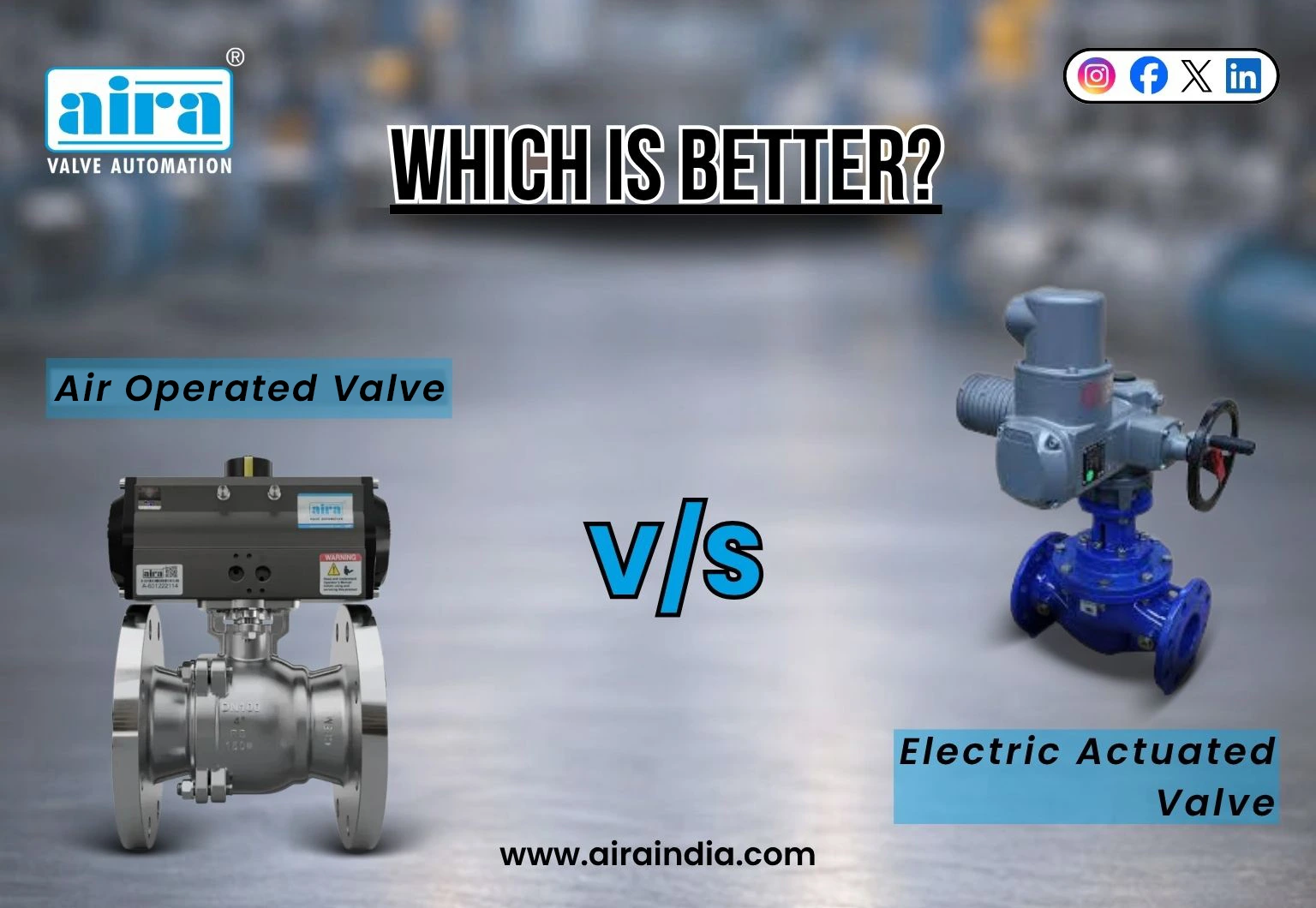
An air operated valve (also called a pneumatic actuated valve) uses compressed air to move the pneumatic actuator, which opens or closes the valve. The actuator converts air pressure into mechanical motion, either rotary (for ball and butterfly valves) or linear (for globe and gate valves).
Key components:
- Pneumatic Actuator (rack & pinion, scotch yoke, or diaphragm type)
- Solenoid Valve (to control air direction)
- Valve body — Ball Valve, Butterfly Valve, Control Valve, etc.
- Optional: Positioner for throttling control
Aira Euro manufactures a complete range of pneumatic actuators:
- Rack & Pinion Aluminum Single Acting Actuator
- Rack & Pinion SS Single Acting Actuator
- Scotch Yoke Single Acting Actuator
What is an Electric Actuated Valve?
An electric actuated valve (motorized valve) uses an electric motor to drive the valve to an open or closed position. The motor is connected to a gearbox, which provides the torque needed to move the valve stem.
Key components:
- Electric motor (AC or DC)
- Gearbox for torque multiplication
- Position feedback (limit switches or encoder)
- Control interface (4–20 mA, on-off, Modbus)
Full Comparison: Air Operated vs Electric Actuated Valve
| Parameter | Air Operated Valve | Electric Actuated Valve |
|---|---|---|
| Power source | Compressed air (4–7 bar) | Electricity (AC/DC) |
| Speed | Very fast (< 1 second) | Slower (5–60 seconds) |
| Fail-safe | Excellent (spring return) | Limited (needs battery backup) |
| Hazardous area | Excellent (no electricity) | Requires ATEX certification |
| Maintenance | Low (simple mechanism) | Higher (motor & gearbox) |
| Initial cost | Lower | Higher |
| Throttling | Needs positioner | Built-in (modulating type) |
| Temp. range | -20°C to +150°C (std) | -20°C to +70°C (std) |
| Remote monitoring | Via positioner (HART) | Built-in (Modbus, Profibus) |
When to Use an Air Operated Valve
- Hazardous/explosive environments: No electricity at the valve no spark risk. No ATEX needed for actuator.
- Fast cycling applications: open/closes in under 1 second. Ideal for filling machines and high-speed processes.
- Fail-safe requirement: Spring-return actuators automatically go to safe position when air supply fails.
- Outdoor and harsh environments: Robust, weatherproof, performs in dusty, wet, and high-temperature conditions.
- Large torque at low cost: For large valves above 6″, pneumatic actuators give high torque at lower cost.
When to Use an Electric Actuated Valve
- Remote locations without compressed air eliminate the need for air compressors and pipelines.
- Precision modulating control, very accurate position control (0.1% resolution) without a separate positioner.
- Low cycling frequency is efficient for valves that open/close only a few times per day.
- Smart plant integration, easy integration with SCADA and DCS via Modbus/Profibus communication.
Why Choose Aira Euro for Pneumatic Actuated Valves?
Aira Euro Automation Pvt. Ltd., headquartered in Ahmedabad, Gujarat, is a leading manufacturer of pneumatic actuators and air operated valves in India.
Explore Aira Euro Pneumatic Actuator Range:
- Rack & Pinion Aluminum Single Acting Actuator
- Rack & Pinion Aluminum Double Acting Actuator
- Scotch Yoke Single Acting Actuator
- 3-Position Pneumatic Actuator
- Pneumatic Linear Diaphragm Actuator
- All Pneumatic Actuators
Contact Aira Euro: https://www.airaindia.com/contact/
Frequently Asked Questions
What is an air operated valve?
An air operated valve is a valve automated by a pneumatic actuator that uses compressed air to open, close, or control the valve position. It is also known as a pneumatically actuated valve or AOV.
Which is faster pneumatic or electric actuated valve?
Pneumatic (air operated) valves are significantly faster they can open or close in under 1 second. Electric actuators typically take 5–60 seconds depending on valve size and motor speed.
Are air operated valves safe for hazardous areas?
Yes. Air operated valves are inherently safe for explosive and hazardous areas because they use compressed air instead of electricity at the valve location, eliminating spark risk.
What is a spring return pneumatic actuator?
A spring return (single-acting) pneumatic actuator uses air pressure to move the valve in one direction and a built-in spring to return it to the safe position when air supply is lost.
Can an air operated valve be used for throttling?
Yes. With a valve positioner added, an air operated valve can be used for precise throttling control. Electro-pneumatic positioners enable accurate flow control with pneumatic actuators.
What is the difference between single acting and double acting pneumatic actuator?
A single acting actuator uses air in one direction and a spring for return — providing fail-safe operation. A double acting actuator uses air in both directions faster and stronger but without automatic fail-safe.