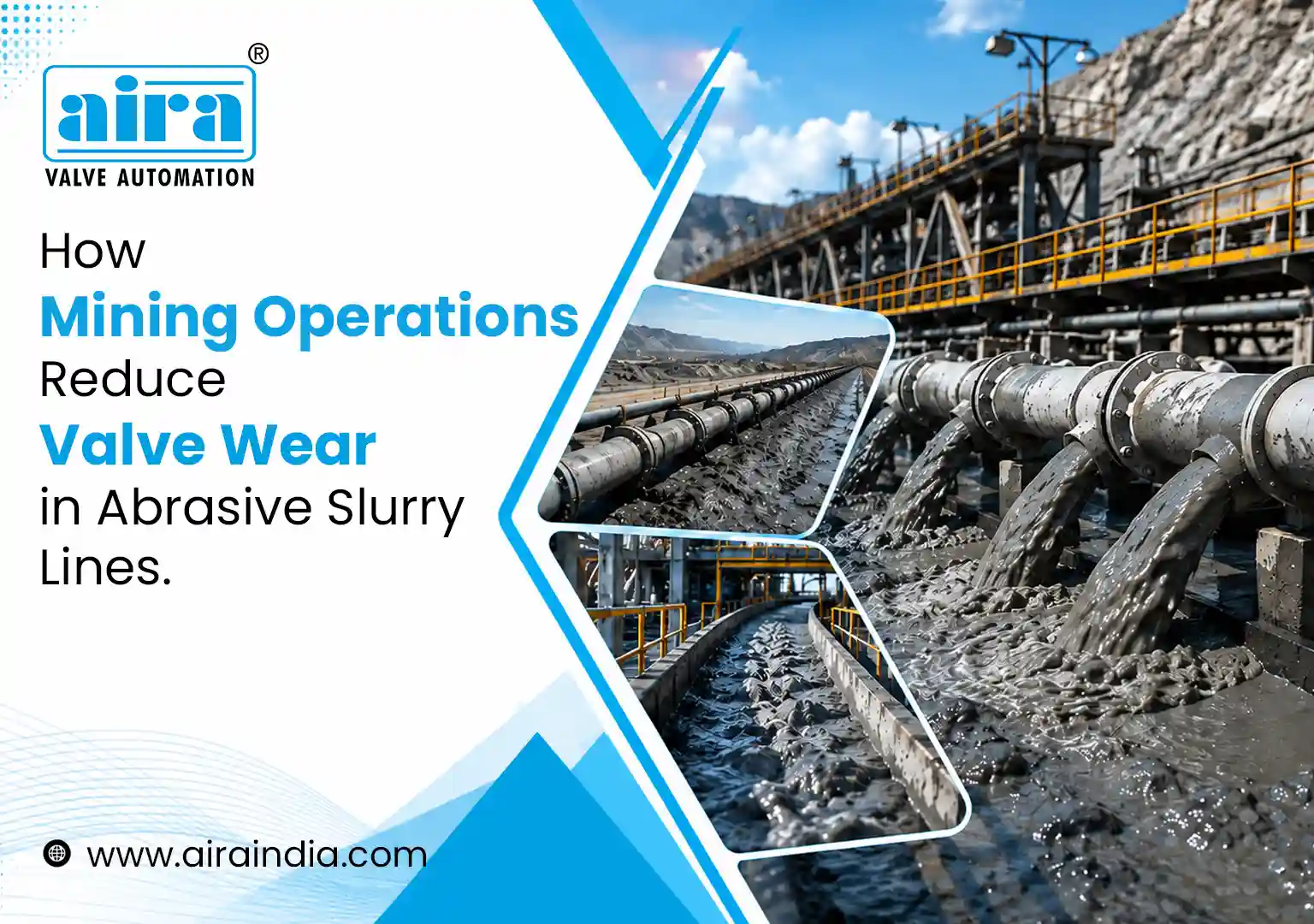
Slurry handling is arguably the toughest service a valve can be put through. Mining operations move enormous volumes of ore fines, tailings, and mineral concentrate suspended in water — mixtures that are dense, abrasive, and often chemically aggressive at the same time. Every valve sitting in that flow path is essentially being sandblasted from the inside, continuously, for as long as the plant runs.
Aira Euro Automation has supplied valve systems into mineral processing and mining applications where abrasive wear is the single biggest driver of maintenance cost. What we’ve learned from these installations is that valve wear in slurry service isn’t really about finding an “indestructible” valve — it’s about understanding exactly how erosion happens in a given line, and selecting valve geometry, material, and operating strategy to work with that reality instead of against it.
Why Slurry Lines Are So Hard on Valves
Abrasive wear in slurry service happens through a few distinct mechanisms, and each one attacks a valve differently.
Erosive wear occurs where solid particles strike valve internals at high velocity — typically at the seat, disc edge, or ball surface where flow direction changes or velocity increases through a partially closed valve. This is the dominant wear mechanism in most mining slurry applications.
Turbulence-induced wear happens downstream of any restriction or throttling point, where particle-laden flow becomes turbulent and particles impinge on surfaces from multiple angles rather than a single direct path.
Cavitation erosion can occur in control applications where pressure drops sharply across a partially open valve, causing vapor bubbles to form and collapse violently against nearby metal surfaces — this compounds abrasive wear rather than replacing it.
Chemical attack, often overlooked, adds to the problem when process water carries dissolved minerals, low pH from ore processing chemicals, or oxidizing agents that weaken metal surfaces and make them more susceptible to erosion.
The combination of these mechanisms means a valve that looks fine after a few weeks can fail rapidly once wear reaches a tipping point — a thinned seat or worn disc edge accelerates erosion further, because it changes the flow pattern and increases local velocity and turbulence.
Valve Selection Strategy for Abrasive Slurry Service
The most effective way mining operations reduce valve wear is by matching valve type to the specific role the valve plays in the line — isolation, throttling, or on/off control each demand a different design approach.
- Knife edge gate valves are one of the most effective solutions for slurry isolation duty. Their design — with a sharpened, wedge-shaped gate — is built specifically to cut through settled solids and maintain a clean shut-off even in heavily loaded slurry lines, in both uni-directional and bi-directional configurations depending on flow requirements.
- Knife edge gate valves in uni-directional design suit applications with a single, predictable flow direction, such as tailings discharge lines, while bi-directional variants are used where flow direction can reverse, such as in certain thickener underflow and recycle applications.
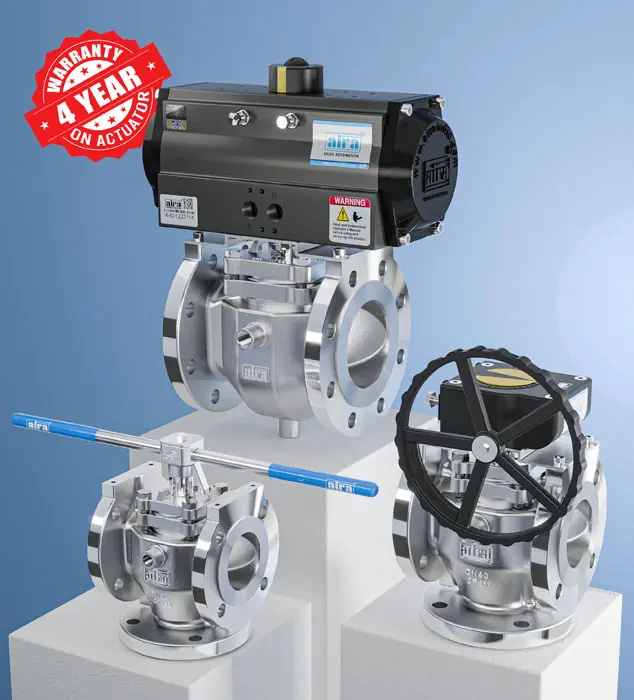
- Plug valves, particularly full-port designs, offer a straight-through bore that minimizes turbulence and flow restriction, reducing localized erosion at the valve itself compared to designs with more complex internal geometry.
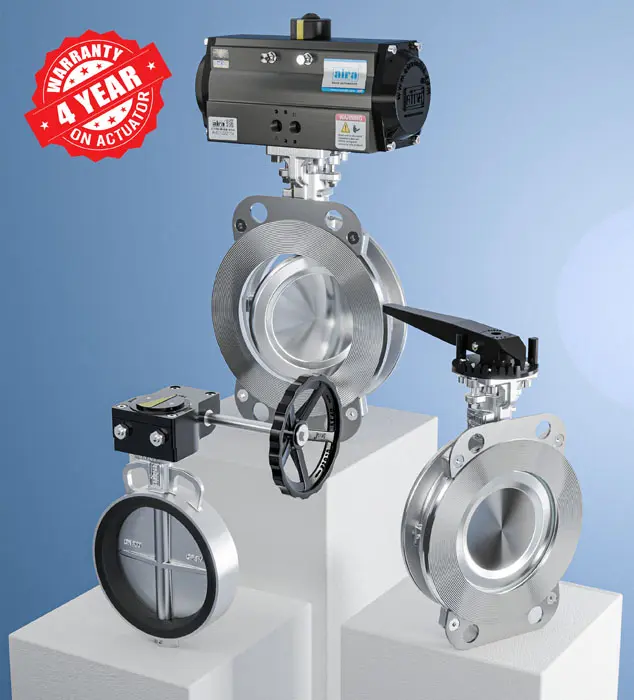
- Butterfly valves with hardened discs and seats are used in lower-abrasion slurry duty and process water lines feeding the slurry circuit, where cost and space efficiency matter alongside wear resistance.
- Control valves used for slurry throttling need to be sized carefully to avoid running in a high-velocity, partially open position for extended periods, since that’s where erosive and cavitation wear compound fastest.
Also Read: Why Textile Dyeing Units Need Corrosion-Resistant Valve Systems
Operating Practices That Reduce Wear Alongside Valve Selection
Even the best-selected valve wears faster if operating practice works against it. Mining plants that get the longest valve life typically follow a few consistent principles:
- Avoid using isolation valves for throttling. Gate and plug valves designed for full-open/full-closed duty wear rapidly if used to partially throttle flow, since partial opening concentrates erosion at the seat edge.
- Size control valves for the actual velocity range, not just peak flow — oversized control valves running mostly closed see far more localized wear than correctly sized ones running closer to mid-stroke.
- Minimize valve cycling where possible. Frequent open-close cycling on abrasive service accelerates seat and seal wear compared to valves that operate in a stable position for longer periods.
- Flush lines before closing isolation valves where practical, to reduce the settled solid load the gate or plug has to cut through on closure.
- Plan wear-part replacement proactively based on known erosion rates for each line, rather than waiting for a failure that can cause unplanned production loss.
Material and Design Choices That Extend Valve Life
Beyond valve type, several design decisions directly affect how long a valve lasts in slurry service: hardened or replaceable seat inserts that can be serviced without replacing the whole valve body, gate and disc surfaces treated or coated for wear resistance, and actuator sizing with enough torque margin to operate reliably even as internal friction increases with wear. Pneumatic actuators sized correctly for slurry valve torque requirements — including the higher breakaway torque that abrasive buildup can cause — help avoid actuator strain that leads to slow or incomplete valve operation.
Aira Euro Automation’s Approach to Slurry and Mineral Processing Valves
With over 1,50,000 sq. mtrs of manufacturing capacity and in-house CNC machining and R&D, Aira Euro Automation builds valve systems designed for the demanding realities of mineral processing and mining applications. Our knife edge gate valve range, available in both uni-directional and bi-directional configurations, is engineered specifically for slurry isolation duty, while our plug and butterfly valve lines offer the flow-path and material options needed across different points in a mining circuit.
We work directly with mining and mineral processing engineers to understand the specific ore characteristics, particle size, concentration, and velocity profile of each line, because generic slurry valve recommendations rarely hold up against the specific abrasion conditions of a real operation.
Reduce Your Slurry Line Downtime
If your mining operation is replacing slurry valves more often than the plan allows for, it’s worth a technical review of valve type, sizing, and operating practice before your next shutdown.
Contact Aira Euro Automation to discuss your slurry line valve requirements, or explore our knife edge gate valve range built for abrasive mining service.
Frequently Asked Questions
What is the best valve type for isolating abrasive slurry lines in mining?
Knife edge gate valves are generally an effective choice for slurry isolation because their sharpened gate can cut through settled solids and provide reliable shut-off in heavily loaded slurry service. The final valve selection should consider slurry concentration, particle size, pressure, temperature, and flow conditions.
Why do valves wear out faster when used for throttling instead of isolation?
Partially open valves can concentrate flow velocity and turbulence around the seat and closing element, accelerating erosive wear. Valves designed primarily for full-open and full-closed operation are generally not intended to handle the localized high-velocity flow associated with continuous throttling.
How does cavitation contribute to valve wear in slurry service?
A sharp pressure drop across a partially open valve can cause vapor bubbles to form and collapse against nearby surfaces. In abrasive slurry applications, cavitation damage can combine with particle erosion, accelerating wear of valve components and potentially shortening service life.
Should uni-directional or bi-directional knife edge gate valves be used in mining applications?
The choice depends on the flow direction and process requirements. Uni-directional knife edge gate valves are suitable for systems with a predictable single flow direction, while bi-directional designs are useful where flow may reverse, such as certain thickener underflow and recycle applications. Always verify the manufacturer’s flow-direction requirements before installation.
Can hardened seats and discs extend valve life in abrasive service without changing the valve type?
Yes. Hardened or replaceable seat inserts and wear-resistant disc coatings can help extend service intervals in abrasive applications. However, material upgrades should be combined with correct valve selection, proper sizing, and suitable operating practices to achieve the best overall service life.