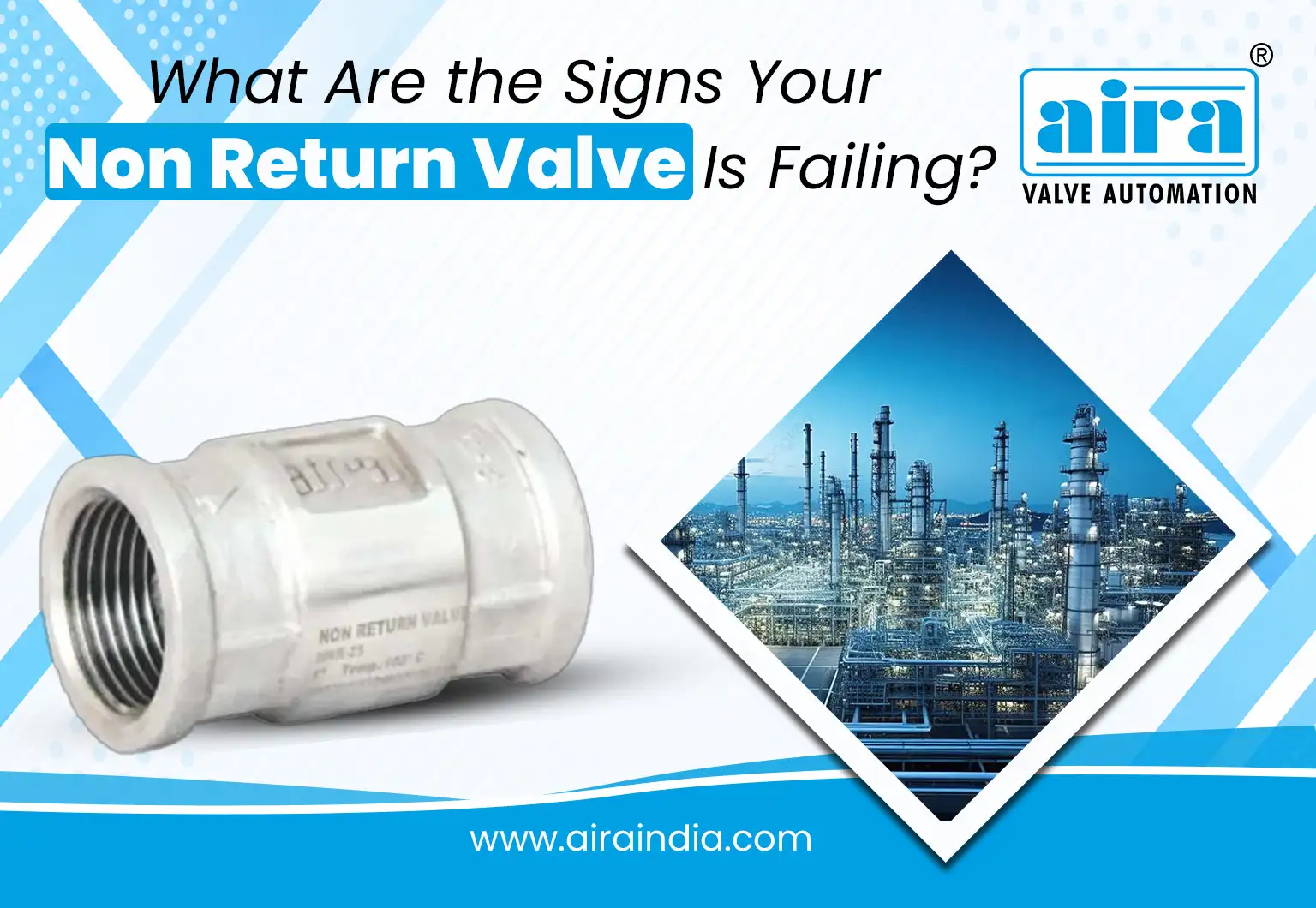
Non return valves are designed to do their job silently. They open with forward flow, close when flow stops or reverses, and protect downstream equipment from backflow — all without any signal, actuator, or human intervention. When they are working correctly, you do not notice them.
When they start failing, the consequences can range from minor process inefficiency to significant equipment damage. A non return valve that fails to close properly on a pump discharge line can allow the system to drain back through the pump, causing reverse rotation, seal damage, and in some cases, complete pump failure. In chemical systems, backflow through a failed NRV can cause cross-contamination between process streams.
Knowing the early warning signs allows you to catch a failing non return valve before it causes downstream damage.
How Non Return Valves Fail
Non return valves fail in two fundamentally different ways:
- Failure to close (backflow) — The valve does not seal properly when flow reverses. This is the most dangerous failure mode because it allows backflow that can damage pumps, compressors, and other equipment or cause process contamination.
- Failure to open (flow restriction) — The valve gets stuck in the closed or partially open position, restricting forward flow. This causes a pressure drop, reduced flow capacity, and process performance problems.
Both failure modes have recognisable signs, and understanding which failure mode is occurring helps direct the diagnosis.
Warning Signs of a Failing Non Return Valve
1. Water Hammer or Pressure Surges
Water hammer the distinctive banging or thudding sound in a pipeline, is one of the earliest and most common indicators of a non return valve that is not closing quickly or completely.
When a pump stops, the forward flow momentum carries fluid into the valve. If the valve closes slowly or incompletely, the decelerating fluid column hits the closed valve with a sharp pressure pulse. This generates noise, vibration, and pressure spikes that stress the pipeline, fittings, and connected equipment.
A properly functioning dual plate check valve or spring-loaded NRV should close fast enough to prevent significant backflow before sealing. If water hammer events are increasing in frequency or severity, it is worth inspecting the NRV — the spring may have weakened, the hinge pin may be worn, or the seating surface may be damaged.
2. Reverse Rotation of Pumps After Shutdown
When a centrifugal pump on a horizontal discharge line is shut down, properly functioning non return valves should prevent the liquid in the discharge line from draining back through the pump. If the pump impeller is observed spinning backward after shutdown — which is audible as a characteristic reverse-running sound — the non return valve is not sealing.
Reverse rotation causes wear on pump bearings and seals, can damage the mechanical seal face, and in some pump types can unscrew the impeller from the shaft. If a pump is regularly exhibiting reverse rotation after shutdown, the NRV on the discharge line needs immediate inspection.
3. Increased Energy Consumption
A non return valve that is not opening fully — stuck partially closed due to a corroded or damaged closing element — adds pressure drop to the system. The pump or compressor must work harder to push fluid through the restricted valve, which shows up as increased power consumption.
Also read, What’s the Difference Between a One-Way and Non-Return Valve?
This sign is subtle and easy to miss unless energy consumption is being monitored. Comparing current pump power draw to the baseline established at commissioning or last maintenance is a practical way to detect developing flow restrictions.
4. Unusual Noise From the Valve
A non return valve in normal operation should be essentially silent. Abnormal noises are a signal that something is wrong:
- Chattering or rattling — The closing element is oscillating repeatedly rather than staying stable in the open position. Caused by a flow velocity that is insufficient to hold the closing element fully open. This is typically a sizing issue but it can also be caused by a weakened closing spring or a worn hinge.
- Continuous grinding or squealing — Suggests the closing element is in contact with the valve body during forward flow. Indicates severe wear on the pivot or hinge, or a closing element that has shifted out of alignment due to damage.
- Intermittent thumping at shutdown — Backflow is occurring before the valve closes — a water hammer symptom indicating the valve is not closing quickly enough.
5. Visible External Leakage
While non return valves do not have moving stems that pass through the pressure boundary, they can develop external leakage through body joints, bonnet connections, or flange faces. Visible drips or weeping at the body joint or bonnet indicate that the joint integrity has been compromised — possibly by repeated pressure surges from water hammer, thermal cycling, or corrosion of joint surfaces.
External leakage from an NRV is a safety and environmental concern that requires immediate attention.
6. Process Cross-Contamination or Backflow Evidence
In chemical or multiple-fluid systems, the clearest evidence of NRV failure is direct evidence of backflow — a process stream contaminated with fluid from downstream, or fluid detected in a line where it should not be present. This is a serious failure that can affect product quality, process chemistry, and in hazardous systems, create safety risks.
7. Reduced Flow Rate or Pressure at Delivery Point
If the flow rate or pressure at the point of use has dropped without a change in pump settings or process demand, a partially blocked or stuck non return valve is one possible cause. The valve closing element may be stuck in a partially closed position, a broken disc fragment may be lodged in the flow path, or corrosion may have reduced the bore area.
How to Test a Non Return Valve
For valves that can be safely isolated and removed from service:
- Visual inspection — With the valve removed, inspect the closing element for wear, corrosion, or damage. Check the seating surface for scoring or erosion. Check the hinge pin or pivot for wear. Look for debris in the flow path.
- Manual function test — With the valve in hand, manually open the closing element and confirm it returns smoothly and completely to the closed position. Check the spring condition if spring-loaded. Look for any binding or stiffness in movement.
- Seat leakage test — Apply a low air pressure to the outlet (downstream) connection while the inlet is open to atmosphere, and observe whether air leaks through. A properly sealing NRV should show zero or minimal leakage at its rated test pressure.
For valves that cannot be removed, ultrasonic flow measurement on the downstream side during a pump shutdown period can detect whether backflow is occurring through a suspected non-return valve.
Common Causes of Non Return Valve Failure
- Erosion and wear — Abrasive particles in the fluid wear the seating surfaces over time, reducing the valve’s ability to seal. Most common cause of gradual seat leakage.
- Corrosion — Incompatible materials in corrosive service cause body or trim corrosion that progressively damages seating surfaces and can eventually jam the closing element.
- Spring fatigue — In spring-loaded check valves, the closing spring fatigues over time and loses its closing force, reducing sealing pressure and slowing closure speed.
- Hinge pin wear — In swing check valves, the hinge pin wears progressively with each open/close cycle. Worn hinge pins cause the disc to hang at an angle, preventing full sealing.
- Debris accumulation — Solid particles can lodge between the closing element and the seat, preventing full closure.
- Incorrect sizing — An oversized valve that experiences disc flutter at normal flow velocities will wear rapidly at the seat and hinge, leading to premature failure.
When to Replace a Non Return Valve
Non return valves are not complex or expensive components relative to the equipment they protect. In most cases, when a valve shows signs of failure — particularly if the seat is worn, the hinge pin is significantly worn, or the disc is damaged — replacement of the complete valve is more cost-effective than repair.
For larger valves in corrosive service where the body is still in good condition, seat replacement or re-machining may be worthwhile. But for standard valves up to DN150 (6 inch) in most service categories, replacement is typically the right call.
Working with a valve manufacturer in Ahmedabad who holds stock of standard NRV sizes and materials minimises the lead time for replacement and reduces the duration of any process disruption.
Connect With Aira Euro Automation for Non Return Valve Solutions
Aira supplies non return valves and a complete range of industrial pipeline components for process applications across India. Alongside non-return valves, Aira Euro offers ball valves, butterfly valves, control valves, and actuation systems providing a single-source solution for process valve requirements.
Contact Aira Euro today at www.airaindia.com/contact for non return valve enquiries, technical support, or a replacement quotation.
Conclusion
A failing non return valve gives clear signals if you know what to look for: water hammer, pump reverse rotation, unusual noise, flow restriction, or direct evidence of backflow. Catching these signs early allows you to plan a valve replacement before the consequences escalate to equipment damage or process contamination.
Regular inspection, particularly on valves protecting high-value equipment like pumps and compressors, is a straightforward and cost-effective maintenance practice. And when a valve does need replacing, choosing a properly specified replacement from a reliable valve manufacturer in India ensures you get the service life the application demands.
Frequently Asked Questions
How do I know if my non-return valve is not closing properly?
Common signs include water hammer (banging noises during pump shutdown), reverse rotation of the pump after shutdown, or evidence of backflow in the system. The most reliable method is a seat leakage test by isolating the valve, applying low air pressure to the downstream side, and checking for leakage through to the inlet.
Can a non-return valve get stuck open?
Yes. Debris trapped between the disc and seat, corrosion, or damaged internal components can prevent the valve from closing completely. A non-return valve stuck in the open position allows unrestricted reverse flow whenever forward flow stops.
What causes water hammer in a pipeline with non-return valves?
Water hammer usually occurs when the valve closes too slowly or fails to close completely. Standard swing check valves are more susceptible because the disc travels through a wider arc before seating. Upgrading to a spring-loaded dual plate check valve helps minimize water hammer by closing before reverse flow develops.
How often should non-return valves be inspected?
In clean, non-corrosive applications, annual inspection during scheduled maintenance is generally sufficient. For abrasive, corrosive, high-cycle, or critical pump and compressor discharge applications, more frequent inspections are recommended to ensure reliable operation.
Is it worth repairing a non-return valve or should I replace it?
For standard industrial non-return valves up to approximately DN150, replacement is often more economical than repair. Larger valves with sound bodies may be refurbished if replacement seats and internal components are readily available. When spare parts are difficult to source or repair costs become excessive, replacing the valve is usually the better long-term solution.