Quick answer: Water hammer is a sudden pressure spike in a pipeline. It happens when flowing liquid is forced to stop or change direction abruptly, usually because a valve closed too fast or a pump tripped. The spike can be many times your normal operating pressure, so the fix is to slow the change down: slower valve closing, controlled pump stops, non-slam check valves and surge protection.
If you have ever stood near a pump house when a pump trips, you may have heard it: a sharp bang that runs down the pipe as if someone hit it with a hammer. That sound is water hammer, and it is more than noise. It is a pressure wave, and every time it passes through your system it pushes on flanges, gaskets, supports and valve seats.
Most plants live with a little of it for years. Then a gasket fails, a gauge reads zero forever, or a check valve disc turns up in pieces. This guide explains what is really happening inside the pipe, how to estimate the pressure, and what you can do about it.
What is Water Hammer?
Moving liquid has mass, and mass in motion has momentum. When a valve slams shut, all that momentum has nowhere to go. The liquid at the valve stops, the liquid behind it keeps pushing, and a high-pressure wave races back up the pipe at roughly the speed of sound in that liquid. When it reaches a tank or a junction it bounces back, and the pipe feels the pressure swing up and down until friction slowly damps it out.
It can also work in reverse. A sudden pressure drop can make the liquid vaporise (column separation), and when those vapour pockets collapse the result is another violent spike.
What Causes Water Hammer?
- Fast valve closure. Quick-closing solenoid valves, quarter-turn valves shut in a hurry, or an actuator running at its fastest speed.
- Pump trip or power failure. Flow reverses and the check valve has to catch it.
- Check valve slam. Some designs close late, after reverse flow has already built up.
- Starting a pump against an empty or half-filled line, which drives liquid into air pockets at speed.
- Sudden valve opening onto a line with a large pressure difference.
- Trapped air, which compresses like a spring and then throws the liquid back.
How Big Can The Pressure Spike Get?
For an instantaneous stop, the classic estimate is the Joukowsky equation:
ΔP = ρ × a × Δv
- ΔP = pressure rise (Pa)
- ρ = liquid density (kg/m³, about 1,000 for water)
- a = speed of the pressure wave in the pipe (m/s)
- Δv = change in flow velocity (m/s)
Worked example. Water flows at 2 m/s in a steel pipe. Take the wave speed as about 1,200 m/s (a typical figure for water in steel pipe; the exact value depends on pipe material, diameter and wall thickness). A valve shuts instantly:
ΔP = 1,000 × 1,200 × 2 = 2,400,000 Pa = 2.4 MPa, which is about 24 bar
That 24 bar sits on top of your normal operating pressure. On a PN16 line it is a serious problem.
Does closing speed matter? A lot. The pressure wave needs 2L/a seconds to reach the end of the pipe and come back (L is the pipe length). If the valve closes more slowly than that, the returning wave eases the spike.
For a 600 m line: 2L/a = (2 × 600) ÷ 1,200 = 1 second.
For closing times well beyond that, a rough estimate is ΔP ≈ 2 × ρ × L × Δv ÷ Tc, where Tc is the closing time. Close the same valve over 10 seconds and you get ΔP ≈ 2 × 1,000 × 600 × 2 ÷ 10 = 240,000 Pa, about 2.4 bar. Same pipe, same flow, one-tenth of the pressure.
Treat these as estimates for understanding the problem. For long, critical or high-consequence lines, ask for a proper surge analysis.
Signs You May Already Have a Problem
- Banging or knocking when pumps stop or valves operate
- Pipes visibly jumping, or supports that keep working loose
- Flange or gasket leaks that return for no obvious reason
- Pressure gauges that fail, or readings that spike
- Check valve discs and seats wearing out far too early
- Solenoid coils or actuators failing repeatedly on the same line
7 Ways To Prevent Water Hammer
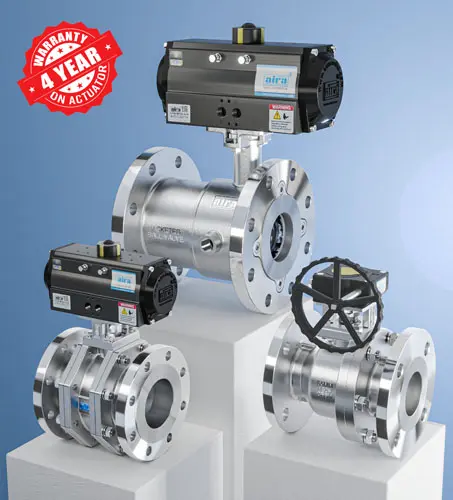
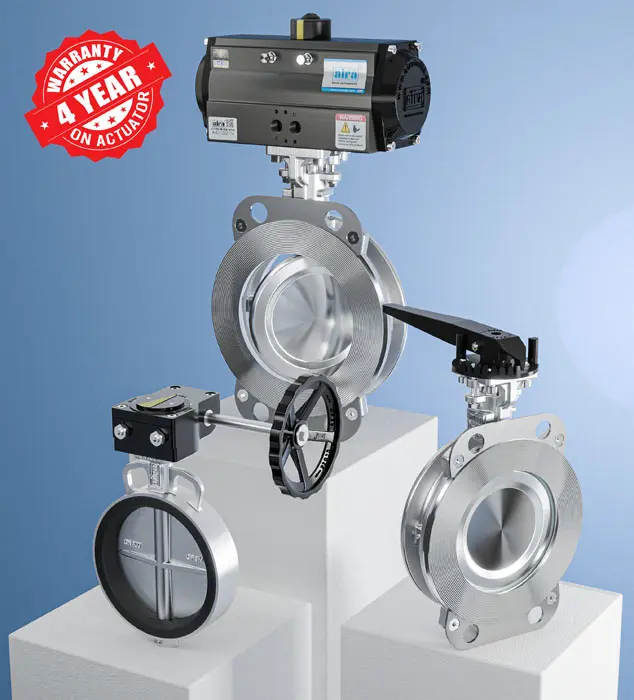
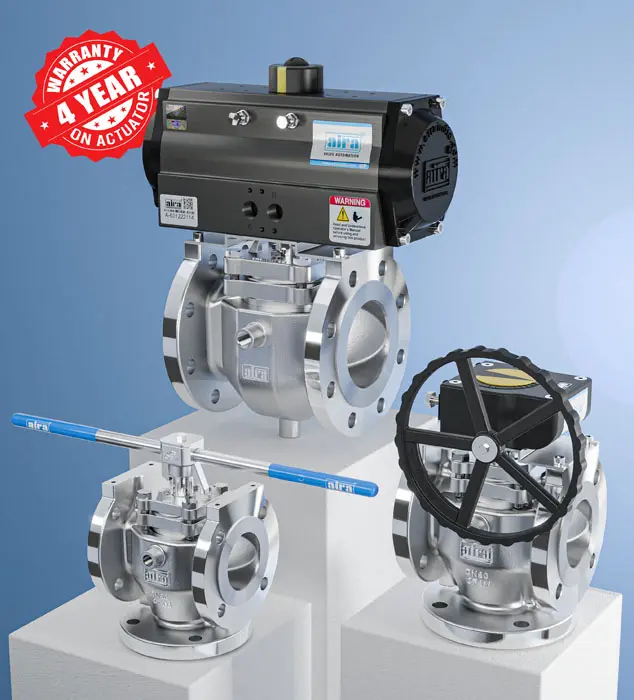
- Open and close valves slowly. Set the actuator speed using speed control on the air line of a pneumatic actuator, and avoid fast-acting valves on long lines. Aim for a closing time well beyond 2L/a. Our pneumatic actuators and pneumatic butterfly valves are used for exactly this kind of controlled operation.
- Control how pumps start and stop. Soft starters or variable frequency drives ramp the flow gently. After maintenance, fill lines slowly instead of starting the pump against an empty pipe.
- Pick the right check valve. A swing check has a long way to travel and can slam when the flow reverses quickly. Spring-assisted or nozzle-type designs close before reverse flow builds up. See our non return valves, and read spring vs swing check valves.
- Keep velocity sensible. Many designers hold water at roughly 1.5–3 m/s in process lines and lower on long runs. Remember that Δv sits right in the formula.
- Add a surge vessel or air chamber. It works like a cushion near the pump or at high points.
- Use surge relief protection. Surge relief valves open to bleed off the spike. Do not assume a standard safety valve sized for steady overpressure will do the same job; transient surge needs its own sizing.
- Get the air out. Fit air release valves at high points, vacuum breakers where needed, and fill slowly after any shutdown.
Which Valves Help, and Which Ones To Watch
| Valve or Device | Water Hammer Risk | What to Do |
|---|---|---|
| Quick-closing Solenoid Valve | High on long or high-flow lines | Choose a slow-closing design, or use the solenoid only to pilot a slower actuator. |
| Quarter-turn valve on an actuator | Moderate to high if it closes in a second or two | Fit speed control and set a longer closing time. |
| Swing check valve | High when flow reverses fast | Move to a spring-assisted or non-slam design. |
| Spring-assisted non-return valve | Lower | Good choice for pump discharge applications. |
| Standard safety valve | Not a surge device | Use a properly sized surge relief solution where required. |
Not sure what closing speed suits your line? Send us your fluid, pipe length, flow rate and pressure. Our engineers will look at it with you. Talk to our technical team
A Quick Checklist Before You Commission or Change a Line
- Work out 2L/a for your longest run
- Compare the pressure rating with operating pressure plus the surge
- Confirm the real closing time of every actuator and solenoid on the line
- Ask what happens on pump trip: which valve closes, and when?
- Check that air release points are where they should be
- After any change, listen and watch the gauges during the first few operations
Need a second pair of eyes on your line? Share your fluid, pipe length, flow rate, pressure and the valves you use today. We will review closing speeds and suggest options that fit your system. Technical support (call or WhatsApp): +91 70436 82683 · Sales: +91 90994 77256 · Email: mkt@airaindia.com
Frequently Asked Questions
What is water hammer in simple words?
It is the bang and pressure spike you get when moving liquid is stopped
suddenly, for example when a valve closes fast or a pump trips. The
liquid’s momentum turns into a pressure wave that travels through the pipe.
What causes water hammer in a pipeline?
The most common causes are quick valve closure, pump trips, slamming check
valves, starting pumps against empty lines and trapped air.
How do you calculate water hammer pressure?
Use the Joukowsky equation, ΔP = ρ × a × Δv. For water at 2 m/s with a
wave speed of 1,200 m/s, an instant stop gives about 24 bar. Slower closing
reduces this a lot.
Can a solenoid valve cause water hammer?
Yes. A solenoid valve that snaps shut can stop flow in milliseconds.
Slow-closing designs, or using the solenoid to pilot a slower actuator,
reduce the surge.
How do you stop water hammer?
Close valves slowly, control pump starts and stops, use non-slam check
valves, keep velocities reasonable, add surge protection and remove
trapped air.