As hydrogen moves from a specialty industrial gas to a mainstream energy carrier — fuel cells, hydrogen refueling stations, green hydrogen production and storage — the valves controlling it face a fundamentally different set of demands than standard gas or liquid service. Butterfly valves are commonly used for isolation and flow control in hydrogen systems, but not every “off-the-shelf” butterfly valve is suitable. This guide covers what actually changes: material selection, sealing design, and actuator requirements.
For a primer on how a butterfly valve works before diving into hydrogen-specific requirements, start with our full guide.
Hydrogen isn’t a new media for industrial valves — Aira Euro Automation’s petrochemical and refining service lines already list hydrogen gas and flare gas hydrogen isolation among the applications served. This guide focuses on what that service actually demands from materials and actuators.
Why Hydrogen Service Is Different
Three properties of hydrogen make it uniquely demanding on valve design:
- It’s the smallest molecule in existence. Hydrogen atoms permeate through metals and elastomers far more readily than other gases, which makes tight, leak-free sealing much harder to achieve and maintain over time.
- It embrittles metal. Hydrogen atoms can diffuse into certain metals and cause internal micro-cracking — known as hydrogen embrittlement — which weakens the material and can lead to sudden failure under stress. Not all steels and alloys are equally susceptible. This is covered in more general terms in our valve materials blog, which looks at material selection across industries and media.
- It has a wide flammability range and very low ignition energy. Hydrogen is flammable across a much broader concentration range in air than natural gas, and it takes far less energy to ignite. This has direct consequences for actuator selection, addressed below.
Material Selection for Hydrogen Butterfly Valves
Body and Disc Materials
Austenitic stainless steels — particularly 316/316L — are widely regarded as a strong baseline for hydrogen service. Their low carbon content and metallurgical structure make them significantly more resistant to hydrogen embrittlement than high-strength or strain-hardened steels, and they retain toughness at low temperatures, which matters if the application involves cryogenic liquid hydrogen (LH2).
For higher-pressure or more demanding duty, duplex and super duplex stainless steels — available on Aira’s double offset butterfly valve range — are often specified, combining strength with good embrittlement resistance. High-strength, strain-hardened components — including valve springs — are generally more vulnerable to hydrogen embrittlement than standard 316 stainless and should be evaluated carefully if used anywhere in the valve assembly.
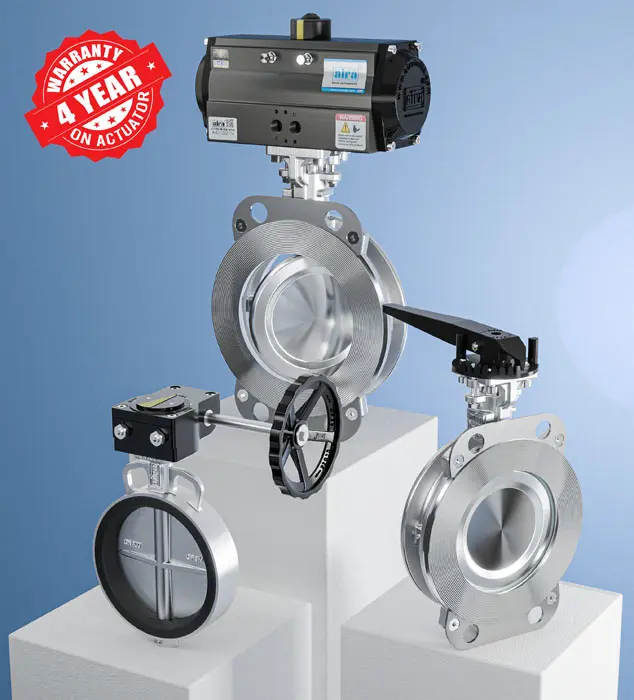
These material choices connect closely to valve body style as well — see our full breakdown of types of butterfly valves for how offset design and material selection work together across the range.
Seat and Seal Materials
This is where hydrogen service diverges most from general industrial valve selection:
- PTFE, PEEK, and PCTFE are commonly used for seats and seals in hydrogen applications because they combine chemical compatibility, low-temperature performance, and resistance to a failure mode called explosive decompression — where absorbed gas rapidly expands and damages the material as pressure drops.
- Standard elastomers need scrutiny. Many general-purpose elastomers allow hydrogen to permeate through them, leading to gradual “outgassing” and seal degradation over time. Any elastomer used in hydrogen service should be specifically qualified for it — not simply assumed compatible because it works for other gases.
- Metal seats are used in some higher-pressure or higher-temperature hydrogen designs, trading some manufacturing complexity for a sealing surface that isn’t subject to permeation at all — the same principle behind Aira’s triple offset, metal-seated butterfly valve designs used in other zero-leakage industrial applications.
Gas vs. Liquid Hydrogen: Know Which You’re Designing For
Compressed hydrogen gas service and liquid hydrogen (LH2) service are not the same specification:
| Parameter | Compressed Gas H2 | Liquid Hydrogen (LH2) |
|---|---|---|
| Temperature | Ambient | Cryogenic, around -253°C |
| Typical pressure | Can reach 700–1000 bar in fueling applications | Lower pressure, but extreme cold drives material choice |
| Key material concern | Embrittlement, permeation | Embrittlement + low-temperature toughness/brittleness |
A material or seal that performs well in ambient compressed hydrogen gas service may not be appropriate for cryogenic liquid hydrogen without separate qualification.
Actuator Considerations for Hydrogen Applications
Material selection covers the wetted parts, but the actuator — especially if it’s pneumatic or electric — has its own set of hydrogen-specific requirements, mainly driven by hydrogen’s explosion risk profile.
Explosion-Proof Certification: Group IIC, Not Just IIB
Electric actuators used in hazardous areas need ATEX or IECEx certification — but the gas group matters. Most general industrial chemical service is certified for Group IIB. Hydrogen specifically requires Group IIC protection, a stricter classification reflecting hydrogen’s low ignition energy and wide flammability range. Specifying an actuator rated only for Group IIB in a hydrogen application is a common and serious mistake.
Fail-Safe / Spring-Return Design
For isolation valves in hydrogen systems, many designs call for spring-return, fail-safe actuation — so the valve automatically moves to a safe position (typically closed) on loss of power or control signal, rather than staying in its last commanded state. Whether this is required depends on the specific application and safety case, but it’s a standard consideration in hydrogen system design.
Enclosure and Temperature (T) Rating
Beyond the gas group, explosion-proof actuators are rated by enclosure integrity (IP rating) and surface temperature class (T-rating), which limits how hot the actuator housing can get without risking ignition of a surrounding hydrogen atmosphere. Both need to be matched to the specific hazardous area classification of the installation (Zone 1, Zone 2, etc.), not assumed from a generic “explosion-proof” label.
Manual Override
A manual override is standard practice on actuators in critical hydrogen isolation service, allowing safe manual operation during maintenance, testing, or in the event of actuator failure.
Standards Commonly Referenced for Hydrogen Valve Service
When evaluating a butterfly valve for hydrogen duty, these are the standards most often cited in specifications:
- ASME B31.12 — Hydrogen Piping and Pipelines
- ISO 19880 — Gaseous hydrogen fueling stations
- NACE MR0175 / ISO 15156 — Materials for use in corrosive/embrittling environments
- ATEX / IECEx — Explosion-proof actuator certification, with attention to gas group (IIC for hydrogen)
Not every valve or actuator on the market is tested or certified against these standards, even if the base materials are theoretically compatible. It’s worth asking any supplier directly which standards their hydrogen-service products have actually been evaluated against, rather than inferring suitability from material specs alone.
Where This Leaves Material Selection in Practice
Butterfly valves built with 316L or duplex stainless steel bodies, hydrogen-qualified seat materials (PTFE/PEEK/PCTFE), and explosion-proof actuators rated for Group IIC reflect the material and actuation profile the industry generally associates with hydrogen suitability. That said, material compatibility on paper is not the same as a certified, tested product — application-specific verification with a qualified engineering team is the right step before specifying any valve into a hydrogen system, particularly for safety-critical or high-pressure duty.
This guide is intended as general technical reference. Browse the full range of butterfly valves manufactured by Aira Euro Automation, or speak with our engineering team about application-specific material and certification guidance for your hydrogen project at Aira Euro Automation.