Large-bore pipelines carry enormous responsibility. In oil & gas transmission, power generation, and petrochemical processing, a single 12-inch or 16-inch line can be the backbone of an entire facility’s operation.
And yet, the valve decisions made for these pipelines often don’t reflect that responsibility. Engineers specify what works on smaller lines. Procurement teams go with what’s available. And nobody thinks twice about it until there’s a torque failure, a seal breakdown, or an emergency shutdown that brings an entire process line to a halt.
Large-bore pipeline problems are rarely dramatic at first. They build slowly. A slightly higher operating torque. A small amount of seat wear. A valve that takes longer to cycle than it used to. And then one day, the system demands full performance — and the valve can’t deliver it.
At Aira Euro Automation, we’ve worked with large-bore pipeline projects across oil & gas, power, and heavy industrial sectors for over 30 years. These are the problems we see most often — and most of them are avoidable.
Why Large-Bore Pipelines Demand a Different Valve Approach
A standard floating ball valve works well in smaller pipelines. The ball floats between two seats, and line pressure helps create the seal. Simple, reliable, cost-effective.
Scale that design up to larger pipe diameters, and the physics change completely.
In large-bore applications, the ball itself becomes significantly heavier. Line pressure pushing against a large-diameter ball creates enormous lateral force on the seats. Operating torque increases dramatically. Over time, the seats wear faster, the stem experiences higher stress, and the whole assembly becomes harder to operate — especially in pneumatic or gear-operated configurations.
This is where floating ball designs start showing their limits. And this is exactly why large-bore pipelines in critical applications require a fundamentally different design — one where the ball is mechanically supported, not floating.
The Problems Nobody Mentions Until They Happen
- Excessive Operating Torque
In large-bore pipelines, a valve that requires high torque to operate creates cascading problems. Actuators get oversized and expensive. Manual gear operation becomes physically demanding. In automated systems, high-torque cycles wear down actuator components faster.
Most engineers don’t calculate torque requirements accurately at the specification stage. They find out the hard way — when the actuator struggles to cycle the valve under full line pressure.
- Seat Wear Under Sustained Load
In a floating ball design under high pressure, the ball constantly pushes against the downstream seat. In a 2-inch valve, this load is manageable. In a 12-inch valve under 300# or 600# pressure class conditions, the continuous load accelerates seat wear significantly.
By the time seat wear becomes visible — through leakage or increased cycle resistance — the damage is already serious. Replacement at that point means taking the line offline, which in critical pipeline systems is a costly disruption.
- Stem and Bearing Stress in High-Diameter Applications
The stem of a large valve carries a significant mechanical load with every cycle. In floating designs, the stem also absorbs some of the lateral force generated by line pressure on the ball. Over thousands of cycles, this creates fatigue stress on the stem and bearing assembly — a failure mode that rarely announces itself until it’s critical.
- Automation Compatibility in Large-Bore Systems
Large-bore pipeline valves in oil & gas and power generation increasingly operate in automated process control systems. A valve that wasn’t specified with automation compatibility — correct ISO mounting, correct torque profile for the actuator — creates integration problems that are expensive to solve after installation.
What Changes When You Use the Right Design for Large-Bore Applications
The design that solves most of these problems is a mechanically supported ball, where the ball is held in position by trunnions above and below, rather than floating between seats. This fundamentally changes how the valve handles load, torque, and wear.
When the ball is fixed in position by a trunnion support, line pressure no longer pushes it against the downstream seat. The seats are spring-loaded and contact the ball independently. This means operating torque stays low even at large diameters and high pressures. Seat wear reduces dramatically. Stem load drops. And the valve cycles consistently across its full service life.
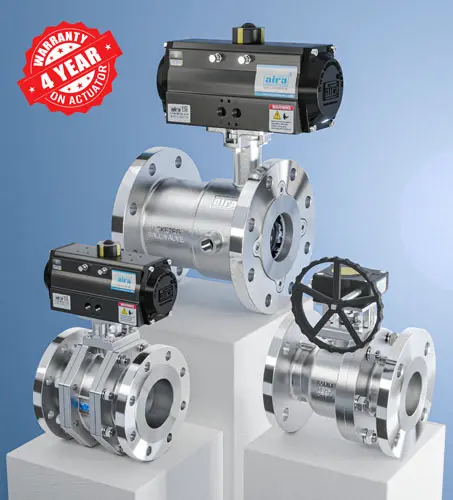
Aira’s trunnion mounted ball valves are available in 2-piece and 3-piece configurations — both internal and external trunnion designs — covering 150#, 300#, and 600# pressure classes. Every variant carries POD, CE, SIL3, FIRE SAFE, EIL, and IBR certifications, and comes with a 4-year actuator warranty.
Internal vs External Trunnion — Which One Is Right
Both designs solve the core problem of floating ball limitations in large-bore pipelines — but they differ in how they do it.
An external trunnion design provides additional mechanical stability through support outside the valve body. It handles high-pressure containment with very low torque, making it the preferred choice for oil & gas transmission and power plant applications where reliability over long service intervals is the priority.
An internal trunnion design integrates the support within the valve body itself. This delivers excellent sealing efficiency and is particularly well suited for corrosive fluid handling and high-temperature service — where the internal geometry helps maintain seal integrity under demanding conditions.
The 3-piece versions of both designs offer an additional advantage: the middle body section can be removed for in-line maintenance without disconnecting the pipeline. For large-bore systems where taking the line offline has a significant operational impact, this is a meaningful maintenance advantage.
Large-Bore Valve Selection Sits Within a Broader Decision Framework
The trunnion vs floating decision is one of several things that determine whether a large-bore pipeline valve performs reliably over its service life. Pressure class, material selection, seat specification, certification requirements, and automation readiness all connect to this decision.
If you’re working through the full valve selection process, our earlier piece, The Valve Decision That Most Plant Engineers Get Wrong and End Up Paying For, covers the complete selection framework across body type, end connection, material, and certifications.
For large-bore systems that also operate under high-pressure conditions, our guide on Why Pipelines Fail Under Pressure And What the Right Valve Selection Actually Looks Like addresses the pressure-rating and material decisions that complement the design choice.
Where Large-Bore Trunnion Designs Are the Right Call
Oil & gas transmission pipelines are the most common application. Large-diameter lines carrying hydrocarbons under sustained high pressure demand the low torque, high-cycle reliability, and fire safe certification that trunnion designs provide.
Power generation facilities — particularly coal and gas-fired plants — use large-bore valves extensively in steam and water circulation systems. IBR approval is mandatory here, and trunnion designs handle the pressure-temperature combination that steam service demands.
Petrochemical and refinery operations use large-bore valves in process lines handling aggressive media at elevated pressures. Material selection — duplex, super duplex, Hastelloy — combined with trunnion support gives these applications both the corrosion resistance and mechanical reliability they require.
For applications where corrosive or aggressive media combines with large pipe diameters, Aira’s lined ball valves offer an additional layer of protection with PTFE and PFA lining options.
The Problems That Don’t Show Up Until It’s Too Late — Are Avoidable
Large-bore pipeline valve failures are rarely sudden. They develop over time — through accumulated seat wear, rising torque requirements, and mounting stem stress. By the time the problem is visible, the cost of addressing it has already grown significantly.
Specifying the right valve design at the start — one that accounts for the actual mechanical demands of large-diameter, high-pressure service — eliminates most of these problems before they begin. The trunnion mounted design isn’t a premium option for large-bore pipelines. It’s the correct engineering specification.
Aira Euro Automation manufactures trunnion mounted ball valves in 2-piece and 3-piece configurations, covering pressure classes from 150# to 600#, in materials including WCB, CF8M, duplex, super duplex, and Hastelloy — all manufactured in-house at our Ahmedabad facility with full quality traceability.
Specifying a Valve for a Large-Bore Pipeline Application?
With over 30 years of experience and exports to 45+ countries, Aira’s engineering team helps you get the specification right before the valve goes in — not after.
Explore Trunnion Mounted Ball Valves: https://www.airaindia.com/ball-valve/trunnion-mounted-ball-valves/
Explore Complete Ball Valve Range: https://www.airaindia.com/ball-valve/
Request a Free Quote: https://www.airaindia.com/contact/